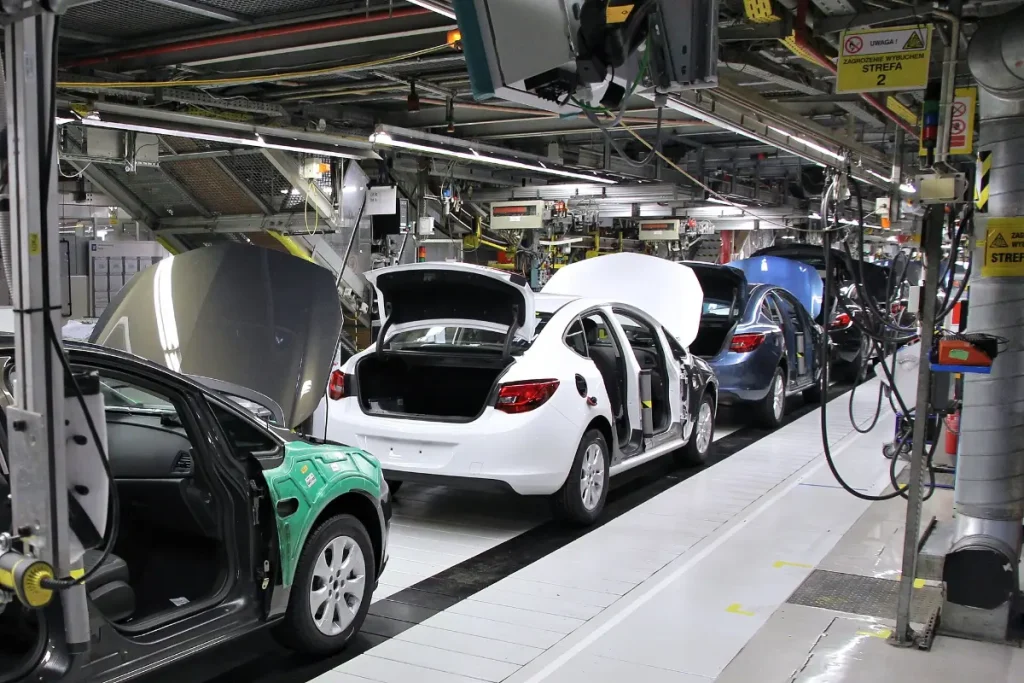
Japan is the world third-largest vehicle producer, with 8.41 million vehicles built in 2025, and its car exports were worth $105.4 billion, according to OICA and World Top Exports figures on our country ranking.
In this article
Home market
- Japan domestic new-vehicle sales fell 3.4% to 381,756 units in October 2026, after several months of growth supported by vehicle tax cuts (JAMA via just-auto).
- GlobalData expects light-vehicle sales to be roughly flat at 4.52 million in 2026, then fall 4% to 4.34 million in 2027.
The tariff bill
US tariffs are the biggest pressure. Seven major Japanese automakers faced combined tariff costs of about ¥2.1 trillion in April-December 2025, including ¥1.2 trillion at Toyota, ¥289.8 billion at Honda, ¥232 billion at Nissan and ¥216.6 billion at Subaru, Jiji Press reported. The Japan-US deal set a 15% tariff on Japanese cars, down from a combined 40% in April 2025.
How the big makers are responding
- Toyota raised its operating profit forecast to ¥3.9 trillion for the year to March 2027 on hybrid demand and a weak yen, but cut its sales forecast.
- Honda is building a $3 billion hybrid plant in Ohio to make more cars inside the US.
- Mazda and Subaru, the most US-exposed, are raising US output, cutting costs and redirecting exports to Europe and other markets.
Our read
Japan strength is hybrids and manufacturing quality; its weakness is a shrinking, ageing home market and heavy exposure to US trade policy. The more Japanese makers build in America, the less work stays in Japanese plants, and the industry says it supports 5.5 million jobs at home.
The home market in numbers
Japan sold 4,565,777 new vehicles in 2025, up 3.3%. Kei cars, the small vehicles limited to 660cc engines, rose 7% to 1,667,360 units, while standard vehicles grew 1.2% (Nippon.com). In the first half of 2026 the market grew 1.8% to 2,387,189 vehicles, with Toyota supplying the five best-selling regular models, the Yaris in first place and the Honda N-Box the top kei car (Best Selling Cars).
| Indicator | Figure |
|---|---|
| Total new-vehicle sales 2025 | 4,565,777 (+3.3%) |
| Kei car sales 2025 | 1,667,360 (+7.0%) |
| First half 2026 | 2,387,189 (+1.8%) |
| October 2026 | 381,756 (−3.4%) |
| GlobalData 2027 outlook | About −4% |
After several months of growth supported by vehicle tax cuts, sales fell 3.4% in October, from 395,189 units a year earlier (Just Auto). GlobalData expects sales to drop about 4% in 2027, to roughly 4.3 million units, as the tax support fades (Just Auto).
Why Japan’s market is unusual
Japan is one of the few large markets where hybrids, not battery-electric cars, dominate new sales, and where kei cars take more than a third of the market. Imported brands are small: mostly German brands such as Mercedes-Benz, BMW and Volkswagen, plus a growing number of Chinese brands such as BYD, together took almost 5% of sales (Just Auto). BYD is even planning an electric kei car to compete in the most Japanese segment of all.
The weak points
- A shrinking, ageing population means the home market cannot grow much over the long term.
- Heavy reliance on the U.S. market leaves profits exposed to tariffs.
- Japanese brands are losing share in China and South-East Asia to Chinese EV makers.
- Nissan’s financial problems remain a risk for the wider supplier network.
What it means for Pakistan
Japanese brands, Suzuki, Toyota and Honda, still dominate Pakistan’s car market, and many models sold here, such as the Alto, Corolla and Civic, are developed with Japan’s engineering base. Japan’s focus on hybrids rather than pure EVs matches Pakistan’s conditions, where charging is limited. But Chinese brands are now winning buyers in Pakistan with plug-in hybrids and EVs, just as they are doing in South-East Asia.
Key takeaways
- Japan is the world’s third-largest vehicle producer, with 8.41 million built in 2025.
- Home sales grew in 2025 and early 2026 but are expected to fall in 2027.
- U.S. tariffs cost Japanese carmakers about ¥2.1 trillion in April–December 2025.
- Hybrids and kei cars define Japan’s market; Chinese brands are a small but growing threat.
Our view
Japan’s carmakers are profitable today thanks to hybrids, a weak yen and strong U.S. demand, but all three supports can change. The long-term risk is that Chinese brands, which already dominate EVs, become competitive in hybrids too, as BYD’s plug-in hybrids are starting to show. Japanese makers that move faster on affordable EVs and software, while keeping their hybrid lead, will be best placed. Toyota looks strongest; Nissan is the most vulnerable.
What to watch next
- Monthly JADA sales data and whether tax support is extended.
- The yen exchange rate and any change in U.S. tariffs.
- BYD’s electric kei car launch and other Chinese moves in Japan.
- Nissan’s restructuring and any new partnerships.
Japan’s big carmakers at a glance
- Toyota: world’s largest carmaker, hybrid leader, strongest profits.
- Honda: shifting from EV plans back toward hybrids; new $3 billion U.S. plant.
- Suzuki: kei-car specialist and market leader in India and Pakistan.
- Nissan: restructuring after heavy losses.
- Mazda, Subaru and Mitsubishi: smaller players most exposed to U.S. tariffs.
Bottom line
Japan’s auto industry is strong today but faces a tougher decade, with a flat home market, tariff risk abroad and Chinese competition in every region.
Elite Autos updates this country report as new monthly sales, production and export data are released by Japanese industry bodies.
Frequently asked questions
How many cars does Japan produce?
8.41 million vehicles in 2025, third in the world after China and the United States.
How much did US tariffs cost Japanese carmakers?
About ¥2.1 trillion for seven major makers in April-December 2025, per Jiji Press.
Sources
- just-auto: Japan domestic market October 2026
- just-auto: GlobalData Japan forecast
- Jiji via Adnkronos: Trump tariffs cost Japan automakers ¥2.1T
- Stocktwits: Japanese automakers in survival mode
This article was prepared with AI assistance and checked against the sources listed. Read our AI use policy and corrections policy.