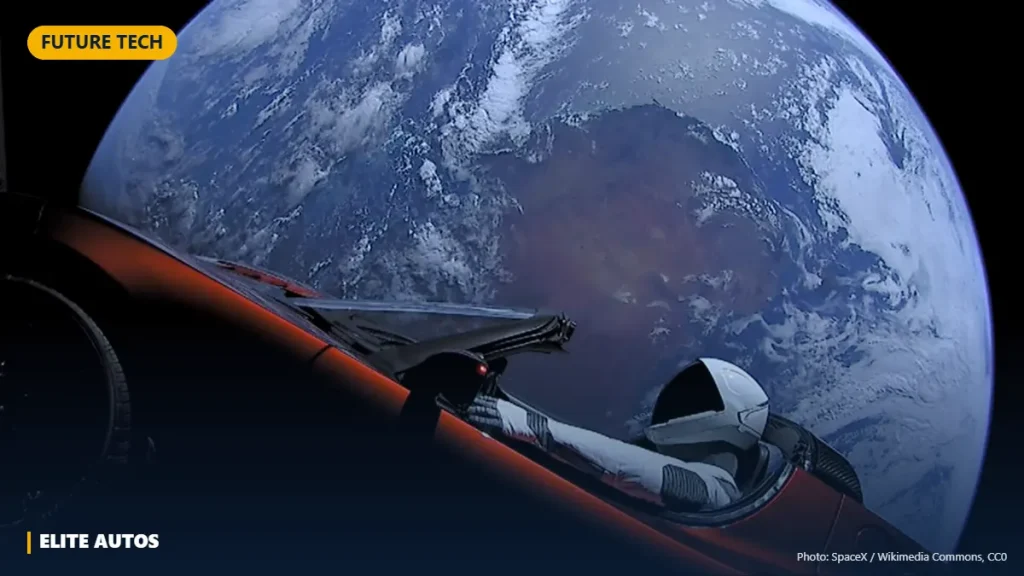
Tesla new Roadster can leave the ground, but it is not a flying car in the way most people imagine one. On October 15, 2026, at SpaceX rocket test site in McGregor, Texas, Tesla showed a driverless Roadster prototype that climbed an inverted ramp using under-body suction fans, left the ramp upside down, used compressed-air thrusters to roll upright and hover for a moment, then landed on its wheels. A second run saw the car jump over a row of Tesla vehicles, including a Semi truck, flip in mid-air and land. “Turns out the future does have flying cars,” Elon Musk said afterwards.
In this article
- What Tesla showed in Texas
- The three Roadster versions
- How the Roadster leaves the ground
- Is it really a flying car?
- From 2017 promise to 2028 production
- Price, deposits and who can buy one
- The other flying cars of 2026
- Comparison table
- The physics: how long can compressed air hold a car up?
- A short history of flying cars
- Safety questions nobody has answered yet
- What to watch in the next 12 months
- Glossary
- Why the law is the real obstacle
- What it means for Tesla
- What it means for buyers worldwide
- Roadster against the fastest cars on sale
- Tesla track record on halo products
- Should you put down a deposit? A checklist
- What the Roadster tells us about the future of cars
- A quick checklist for judging any flying-car claim
- Frequently asked questions
What Tesla demonstrated is a short, controlled hop powered by cold gas, not sustained flight with wings or rotors. Production is now targeted for 2028, eight years after the original 2020 delivery promise, and the version with a “full flight system” will be an invite-only, single-seat car that Musk himself says may not be legal everywhere. This guide explains exactly what was shown, how the technology works, what it will cost, how it compares with the flying cars and air taxis that are actually going into service, and what it means for buyers and for Tesla as a business.
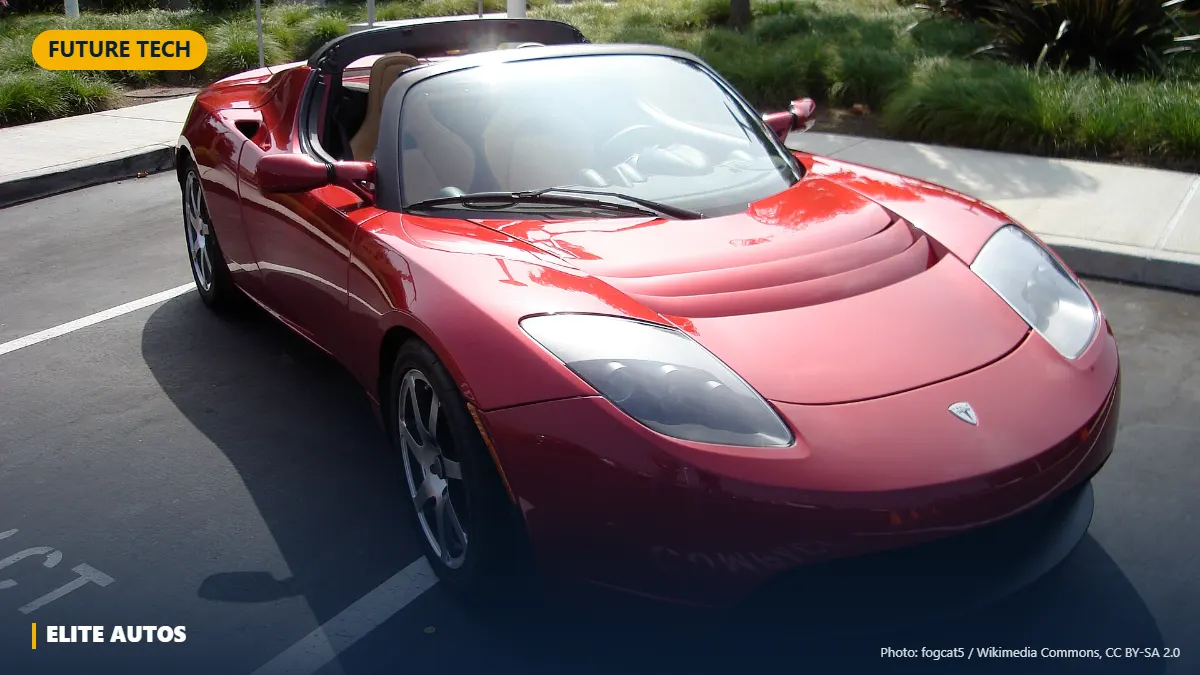
TESLA ROADSTER 2026 AT A GLANCE
ELITE AUTOS
What Tesla showed in Texas
Tesla chose the SpaceX engine test site in McGregor rather than a design studio or a car show, and invited guests to watch in person. Musk said people needed to be there “to prove that it is not AI.” The setting was the message: this was a car built with help from a rocket company, and Tesla wanted the audience to see real hardware moving in real air.
The demonstration had three parts. In the first, the Roadster drove up a curved ramp that bent back over itself, and stayed stuck to the underside of the ramp while upside down. That trick relied on fans under the car that suck it towards the surface. When the car reached the end of the ramp it was flying inverted, parallel to the ground. Compressed-air thrusters then rolled it right side up, it hovered briefly, and it touched down in a cloud of smoke.
In the second part, the car accelerated towards a row of parked Teslas: a Model 3, a Model Y, a Cybertruck, a Cybercab and a Semi. It jumped the row, rotated through a full flip in the air and landed on its wheels. Lars Moravy, Tesla vice president of vehicle engineering, called it “the kickflip,” the skateboard term. In the third, Tesla ran a live acceleration test and recorded 0 to 60 mph in 0.81 seconds.
Nobody was inside the car. Musk told the crowd the car was driving itself “to make sure we do not kill anyone.” That detail matters more than the flip: the airborne parts were run as remote, controlled stunts on a private site, not as a person driving on a public road.
The three Roadster versions
Tesla announced three configurations. They share the same body and electric powertrain, but differ sharply in what they can do and who can buy them.
| Version | What it adds | 0-60 mph (claimed) | Who can buy | Reservation |
|---|---|---|---|---|
| Performance | Road car with active aero and the suction fan system | Under 1.6 s | Open reservations | $50,000 (refundable) |
| Thrust | Adds compressed-gas acceleration thrusters; described as race-ready | Under 0.9 s | Open reservations | $250,000 |
| Rocket | Single seat, full flight system | Under 0.59 s | Invite-only; not in all regions | Not stated |
The Performance version is the one most buyers will actually be able to drive on the road. Its party trick is the suction system rather than thrusters. The Thrust version adds the compressed-air nozzles for acceleration. Only the Rocket version, offered by invitation, carries what Tesla calls a full flight system, and Beinsure reports it is not approved for public roads.
Tesla says the production car will be faster than the demo prototype, as long as it does not, in Musk words, “detach the retina” of the person inside. It also said the Roadster will be the only Tesla that people drive manually in future, positioning it as a “pilot car” while the rest of the range moves towards autonomy.
How the Roadster leaves the ground
1. Suction fans: downforce without speed
Racing cars normally create downforce with wings and the shape of the underbody, which only works at speed. A fan car instead uses powered fans to pull air out from under the car, creating low pressure that sucks it towards the road even when it is moving slowly. The idea is not new: Formula 1 banned fan cars in the late 1970s because they were too effective. Tesla says the Roadster fans can generate up to 2 G of downforce. That is enough, in theory, to hold the car against a surface upside down, and to corner at more than 2 G, compared with about 1.26 G from tyres alone.
Tesla also fitted an active rear wing with two modes, High-Downforce and Low-Drag, and says the wing is moved by actuators from its Optimus humanoid robot programme. Musk joked that the suction could “suck the chrome off a trailer hitch.”
2. Cold-gas thrusters: rocket principle, no rocket fuel
The flying part comes from cold-gas thrusters, the same basic principle SpaceX uses for small attitude adjustments on spacecraft. Instead of burning fuel, the system releases air stored at very high pressure through nozzles, and the reaction pushes the car. According to Tesla figures reported by Not a Tesla App, the Roadster carries two carbon-overwrapped pressure vessels holding about 250 kg of air across 600 litres, feeding 10 nozzles. The car can recharge its own tanks, so it needs no special propellant.
This explains both what the car can and cannot do. Compressed air gives a big push for a few seconds, which is enough for a launch boost, a hop, or to rotate the car in the air. It cannot keep a two-tonne car aloft for minutes. Once the tanks are empty, the car is a car again until the compressor refills them.
3. The powertrain
Tesla says the new Roadster uses a new battery and drive unit that produce 1 megawatt, around 1,340 horsepower, which it describes as one-third more power than the Model S Plaid with half the mass. It claims a top speed above 230 mph today and wants to approach half the speed of sound eventually. Beinsure reports a range above 300 miles, well below the roughly 620 miles Tesla promised for the Roadster in 2017.
4. The design
The 2017 concept looked like a smooth grand tourer. The 2026 car is a low wedge, closer to a Lamborghini in stance, with a full-width rear light bar and an exposed diffuser that houses the fans and nozzles. Designer Franz von Holzhausen cited the SR-71 spy plane and transforming vehicles as inspiration. Inside, the two seats are moulded into the chassis, and the car uses a steer-by-wire yoke with by-wire brakes and throttle.
Is it really a flying car?
That depends on your definition. If a flying car means a vehicle that can drive on roads and also take off, cruise through the air and land under control with a person inside, the Roadster has not shown that. If it means a car that can be airborne briefly under its own power and land safely, then yes, the prototype did that on video in front of witnesses.
Most analysts landed somewhere in between. Gene Munster of Deepwater Asset Management, a Tesla investor, called it “an engineering flex with no commercial value beyond embarrassing traditional car makers.” An aviation commentator on AvWeb compared it to jumping off a porch and landing on two feet. Others pointed out that every claim Tesla made about future flight, from the Rocket version full flight system to sustained hovering, is still unproven.
- What is real: a car that sticks to surfaces with fans, launches harder with thrusters, and can be airborne for a few seconds.
- What is marketing: the phrase “flying car” applied to a car that cannot fly in the aviation sense.
- What is unknown: whether a customer will ever legally use the thrusters on a public road, and how the Rocket version will be certified.
From 2017 promise to 2028 production
| Date | Event |
|---|---|
| November 2017 | Second-generation Roadster concept shown; 0-60 mph in 1.9 s and 250+ mph promised; $50,000 deposit or $250,000 Founders Series |
| 2020 | Original delivery target passes |
| 2025 | Musk tells Joe Rogan a demo will be “unforgettable” |
| Mid 2026 | Demo dates slip repeatedly; Electrek counts at least eight missed internal deadlines |
| August 2026 | Musk posts that “we will have flying cars” |
| October 15, 2026 | Flying demo at SpaceX McGregor, Texas |
| 2028 | New production target |
The delay is not unusual for Tesla halo products. The Semi and Cybertruck also arrived years late. What changed between 2017 and 2026 is the role of SpaceX. The original Roadster was promised with an optional “SpaceX package” of thrusters; the 2026 car turns that into the headline feature, and Musk described the project as a collaboration between “the world best car company and the world best rocket company.”
Price, deposits and who can buy one
Tesla has not announced final prices. Reservations for the Performance version need a $50,000 deposit, and the Thrust version $250,000. In 2017 the Roadster was quoted from $200,000. Given the 1 MW powertrain, carbon pressure vessels and low volumes, expect the Thrust and Rocket versions to cost far more than that. The Rocket version is invite-only and Tesla says it will not be offered in all regions.
- Deposits are not prices. A deposit secures a place in the queue; the final bill comes later.
- Delivery dates have slipped before. Anyone paying a deposit should read the refund terms first.
- Insurance will be a challenge. A car with sub-one-second acceleration and thrusters is not something most insurers have priced.
- Import duties apply. In markets such as Pakistan, India or the Gulf, duties and taxes on a car of this value can add a large share of the price. See our car price converter for currency comparisons.
The other flying cars of 2026
Tesla is not the only company promising to put people in the air. The difference is that several rivals are building aircraft first and cars second.
XPeng Land Aircraft Carrier (China)
XPeng flying-car unit, formerly AeroHT and now trading internationally as Aridge, is building the Land Aircraft Carrier: a six-wheeled ground vehicle that carries a folding two-seat electric multicopter in its rear bay. The aircraft detaches, flies, and returns to be charged by the truck. XPeng president Brian Gu told Reuters early deliveries were expected before the end of 2026, with full-scale production in 2027. Reports put orders at more than 7,000, mostly from China, and earlier reports put the price in China at about $280,000. Unlike the Roadster, this is a real aircraft, though it does not drive and fly as one body.
Alef Model A (United States)
Alef Aeronautics in California began hand-building its Model A Ultralight in December 2025 and calls it the first true flying car to reach production. It is fully electric, can be driven on roads, and is designed to take off vertically and fly. Alef quotes around 200 to 220 miles of driving range and 110 miles in the air, and reported pricing has been around $300,000. First customers are meant to trial it under tightly controlled conditions before production ramps up in 2027.
Joby and Archer air taxis
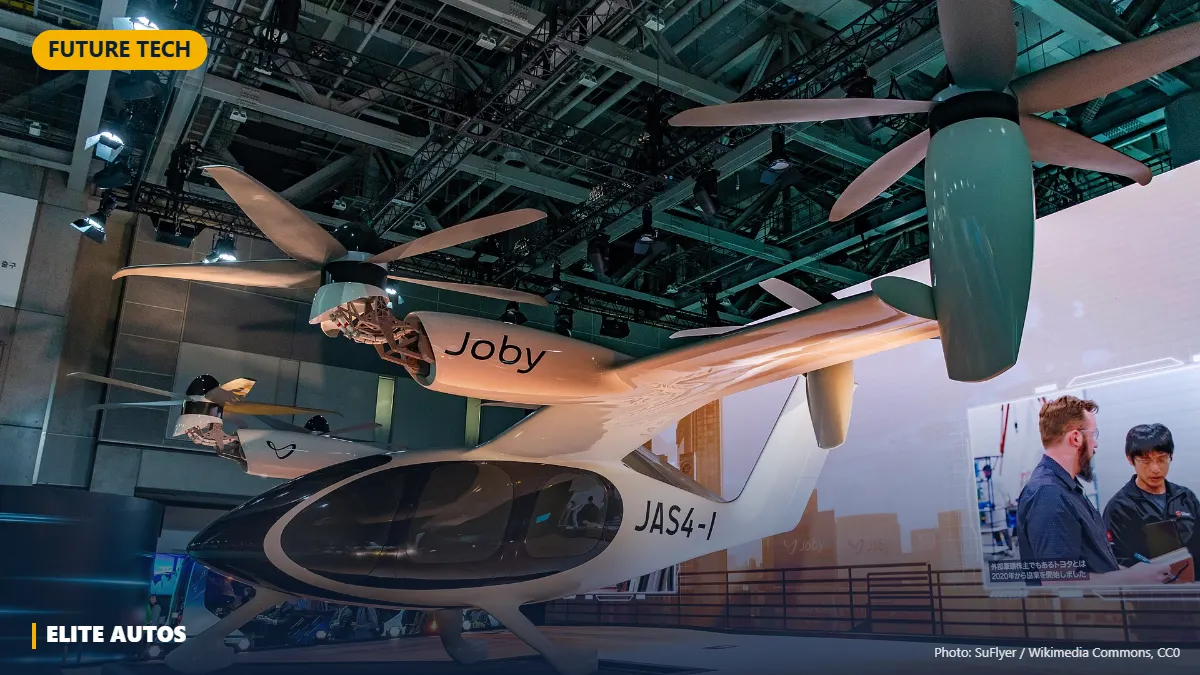
Electric air taxis are the closest thing to flying cars most people will ride. Joby Aviation has an exclusive six-year agreement to run air taxis in Dubai and has been building vertiports there, starting at Dubai International Airport. In the United States, Joby and Archer said in November 2026 that early commercial passenger flights now point to 2027, depending on FAA test milestones, according to AIN. These are aircraft you book like a ride, not cars you own.
Comparison table
| Vehicle | Type | Can it drive? | Can it fly? | Status (Nov 2026) | Reported price |
|---|---|---|---|---|---|
| Tesla Roadster (Rocket) | Sports car with cold-gas thrusters | Yes | Short hops only | Prototype; production 2028 | Not announced |
| XPeng Land Aircraft Carrier | Truck plus detachable eVTOL | Truck only | Yes, aircraft module | Early deliveries targeted end 2026 | About $280,000 (China) |
| Alef Model A | Drive-and-fly electric vehicle | Yes | Yes (designed for VTOL) | Early production, controlled trials | About $300,000 |
| Joby S4 | Air taxi eVTOL | No | Yes | Dubai launch; US passenger flights 2027 | Per-ride service |
Read the table from left to right and the pattern is clear. The vehicles closest to real flight are the ones that gave up on being normal cars. The Roadster is the opposite: it is unmistakably a car, and flight is a stunt feature on top.
The physics: how long can compressed air hold a car up?
Tesla has not published the Roadster weight or the exact thrust of its nozzles, so any estimate is rough. But simple physics shows why the car hops rather than flies. Here is our back-of-envelope calculation, with every assumption stated.
| Input | Value used | Why |
|---|---|---|
| Air carried | About 250 kg | Tesla figure for the two pressure vessels |
| Car mass | About 2,000 kg (assumed) | Tesla has not published a weight; most high-performance EVs weigh 1,800 to 2,300 kg |
| Efficiency of a cold-air thruster | Specific impulse of roughly 50 to 70 seconds | Typical textbook range for cold-gas systems using air or nitrogen |
| Force needed to hover | About 19,600 newtons | Weight of a 2,000 kg car under Earth gravity |
Multiply the air mass by gravity and by a specific impulse of about 60 seconds and you get a total “push” of roughly 147,000 newton-seconds. Divide that by the 19,600 newtons needed to hold the car up and the answer is around seven to eight seconds of hover, if every kilogram of air were used for lift alone and the car got lighter as the air ran out. In practice some thrust goes into steering and stabilising, so real airborne time per tank would be shorter. That matches what the demo showed: a few seconds in the air, not minutes.
To fly for ten minutes the same way, a two-tonne car would need roughly 80 times as much air, which is physically impossible to carry. That is why every serious flying-car project uses wings, rotors or propellers that push against the surrounding air rather than carrying all their reaction mass on board.
A short history of flying cars
People have tried to make cars fly for more than a century. Most projects ended in prototypes, but a few came close to real use. The pattern is consistent: the more a vehicle works as an aircraft, the less practical it is as a car.
| Vehicle | Era | How it worked | What happened |
|---|---|---|---|
| Taylor Aerocar | 1949 | Road car that towed its own wings and tail and attached them to fly | Certified by US aviation authorities in the 1950s; only a handful built |
| Moller Skycar M400 | 1990s to 2000s | Ducted fans for vertical take-off | Hover tests on a tether; never entered production |
| Terrafugia Transition | 2009 onward | Folding-wing roadable aircraft needing a runway | Flight tests; company bought by China Geely in 2017 |
| PAL-V Liberty | 2010s onward | Car that becomes a gyroplane with a folding rotor | Road approval in Europe; flight certification work continues |
| Klein Vision AirCar | 2020s | Car whose wings and tail extend in minutes | Received a certificate of airworthiness in Slovakia in 2022 |
| Samson Switchblade | 2020s | Three-wheel car with folding wings | First flight in 2023; needs a runway |
Two lessons stand out. First, the vehicles that actually flew needed runways and wings, which makes them aircraft that can drive, not cars that can fly. Second, none sold in large numbers, because owners needed a pilot licence, an airfield and insurance for both roles. The new wave of electric vertical take-off aircraft and Tesla thruster approach are both attempts to escape the runway problem in very different ways.
Safety questions nobody has answered yet
- Occupant safety in the air: the demo car had no driver. Tesla has not explained how a person would be protected if a thruster failed mid-flip.
- People nearby: high-pressure air blasts can throw dust and debris. Using thrusters near pedestrians or other cars raises obvious risks.
- Pressure vessels: carbon-overwrapped tanks are used in aerospace and hydrogen cars, but a crash involving tanks at very high pressure needs specific testing.
- Acceleration limits: Musk joked about not wanting to “detach the retina.” Sub-second 0-60 runs put real strain on the body; Tesla will need software limits.
- Insurance and liability: if a thruster-assisted jump goes wrong on a private track, who is liable: the owner, the track or Tesla?
Musk was candid about this on stage, admitting the Roadster is “not necessarily a safety-optimised car.” For a halo product sold in small numbers, that may be acceptable to the buyers it targets. It would not be acceptable for a mass-market car.
What to watch in the next 12 months
- Final pricing for the Performance and Thrust versions, and the refund terms for deposits.
- A demo with a person on board. Until a human rides through a thruster manoeuvre, the flying claims stay theoretical.
- Regulatory filings for the road versions in the US and Europe.
- XPeng deliveries of the Land Aircraft Carrier, which would make China the first country with a privately owned flying-car system on sale.
- Joby and Archer certification steps in the US, and passenger service in Dubai.
- Alef first customer flights under controlled conditions.
FLYING CAR RACE: WHERE EACH PLAYER STANDS
ELITE AUTOS
Glossary
- Cold-gas thruster: a nozzle that releases stored high-pressure gas to create thrust, without combustion.
- Fan car: a car that uses powered fans to suck itself towards the road for grip.
- eVTOL: electric vertical take-off and landing aircraft, such as Joby S4 or the XPeng aircraft module.
- Halo car: a low-volume flagship that showcases a brand technology and image.
- Type certification: the regulator approval that an aircraft design is safe to fly.
- Downforce: vertical force pushing a car onto the road, increasing grip.
Why the law is the real obstacle
Engineering is the easy part of a flying car. Regulation is the hard part. A vehicle that leaves the ground can fall under aviation law, which requires certified aircraft, licensed pilots and controlled airspace. A road car needs to pass crash tests and lighting rules that never imagined thrusters. A vehicle that is both must satisfy two systems written by two different regulators.
- Road rules: the Roadster needs normal type approval for the Performance version, and any public-road use of thrusters raises questions about noise, debris and pedestrian safety.
- Air rules: sustained flight would need aviation certification. That is why Alef targets countries with ultralight rules first, and why Joby launched in Dubai while waiting for FAA steps.
- Local rules: even in the US, state laws vary. Musk said he is “not sure it is necessarily legal in all jurisdictions.”
For the Rocket version, the likely answer is private tracks and invite-only events, much as hypercars such as track-only McLarens and Ferraris are sold today.
What it means for Tesla
Tesla shares rose about 5% in premarket trading the day after the event, Beinsure reported. Morningstar analyst Seth Goldstein said the Roadster could fill a gap as a halo car, a flagship that shows off a brand engineering, which Tesla has lacked. Musk himself described the Roadster as a small contributor to Tesla finances and said its commercial success is uncertain.
The bigger strategic signal is the link between Tesla and SpaceX. The thrusters, carbon tanks and the event site all came from the rocket company. Munster suggested the event showed why Musk might want to combine the two businesses, though no merger has been announced. For investors, the Roadster is marketing and technology transfer, not a volume product. The numbers that move Tesla are still Model Y demand, robotaxi progress and energy storage. See our auto stocks page for live share prices.
What it means for buyers worldwide
- Gulf buyers are the most likely early owners outside the US: the region already buys limited-run hypercars and Dubai is the first city with a commercial air-taxi network.
- China has the most advanced real flying-car project in XPeng Land Aircraft Carrier, and buyers there may own a working personal aircraft before anyone owns a flying Roadster.
- Pakistan and South Asia: a Roadster would face very high duties and taxes, and thruster use would sit outside current rules. For now it is a dream car, not a shopping decision. Our Pakistan auto industry 2026 brief covers what is actually selling.
- Europe will be cautious: strict type approval and noise rules make public-road thruster use unlikely.
For everyone else, the practical takeaway is this: the first “flying car” most people will use is an air taxi booked through an app, not a car parked in their garage.
Roadster against the fastest cars on sale
How does the new Roadster compare with the quickest electric cars buyers can actually order? The table below uses each maker own claims. Remember that Tesla figures are for a car that will not reach customers until 2028, while the others are on sale or close to it.
| Car | Status | Claimed 0-60 mph | Power | Party trick |
|---|---|---|---|---|
| Tesla Roadster Performance | Production 2028 | Under 1.6 s | Not yet split by version; 1 MW drive unit announced | Suction fans for up to 2 G downforce |
| Tesla Roadster Thrust | Production 2028 | Under 0.9 s | Adds cold-gas thrusters | Thruster-assisted launch |
| Tesla Roadster Rocket | Invite-only, 2028 | Under 0.59 s | Full flight system | Short airborne hops and flips |
| Porsche Cayenne Turbo Electric | On sale; at LA Auto Show 2026 | 2.4 s | Up to 1,139 hp | Fastest Porsche SUV ever |
| Rivian R2 (top version) | Launching | 3.6 s | Up to 656 hp | Affordable adventure EV |
The honest takeaway is that today fastest production electric cars already accelerate harder than almost any driver can use on a public road. The Roadster pushes into territory where the limiting factor is the human body, which is why Musk talked about not detaching retinas. For our live coverage of the LA show cars, see LA Auto Show 2026.
Tesla track record on halo products
Tesla history helps set expectations for 2028. Its most ambitious products have tended to arrive late, but they have usually arrived.
| Product | Unveiled | First customer deliveries | Gap |
|---|---|---|---|
| Tesla Semi | 2017 | Late 2022 (to PepsiCo) | About 5 years |
| Cybertruck | 2019 | November 2023 | About 4 years |
| Roadster (2nd gen) | 2017 | Targeted 2028 | About 11 years if on time |
| Cybercab | 2024 (We, Robot event) | Production started April 2026 | About 2 years to production |
On that record, 2028 is plausible for the Performance version and less certain for the Rocket version, which depends on rules Tesla does not control.
Should you put down a deposit? A checklist
- Read the refund terms. Tesla describes the Performance deposit as refundable; confirm how and when refunds are paid in your country.
- Assume the price will rise. The 2017 base price was $200,000; the 2026 car has far more hardware.
- Check your local rules. Ask whether a car with thrusters can be registered where you live, and whether thrusters must be disabled on public roads.
- Think about insurance first. Get a quote, or at least an opinion, before committing.
- Plan for import costs. Duties, sales taxes and shipping can add a large share outside the US. Compare with our currency converter.
- Be ready to wait. Treat 2028 as the earliest date, not a promise.
What the Roadster tells us about the future of cars
Strip away the stunt and the Roadster shows three trends that will reach ordinary cars much sooner than flight. First, by-wire controls: steering, braking and throttle without mechanical links make it easier to add driver assistance and to change how a car feels through software. Second, active aerodynamics: wings and fans that adapt to speed improve both efficiency and grip, and simpler versions already appear on mainstream EVs. Third, shared technology across companies: the Roadster borrowed pressure vessels and thruster know-how from rockets, much as Formula 1 has long fed ideas to road cars.
The other lesson is about marketing. “Flying car” was the phrase that made the event go viral in hours. For carmakers, the race for attention is now as fierce as the race for range or price. Expect more brands to stage dramatic, livestreamed demonstrations rather than traditional motor-show reveals. Our auto shows calendar tracks the big ones, including the LA Auto Show (November 20 to 29) and Auto Guangzhou (November 27 to December 6).
A quick checklist for judging any flying-car claim
- Has the aircraft received a type certificate from the FAA, EASA or another regulator?
- Has it flown with a pilot or passengers outside a controlled test site?
- Is there a price, a delivery date and a named first customer?
- Where will it take off and land legally, and who will maintain it?
If the answer to most of these questions is no, treat the announcement as a concept or marketing event rather than a product you can buy.
Use the same checklist for every air-taxi, eVTOL or flying-car story you read on Elite Autos and elsewhere.
Frequently asked questions
Can the new Tesla Roadster really fly?
It can be airborne for a few seconds. In the October 15, 2026 demo, a driverless prototype launched off a ramp, flipped, used compressed-air thrusters to stabilise and landed. It has not shown sustained flight or take-off from a flat road.
When will the Tesla flying Roadster be available?
Tesla targets the start of production in 2028.
How much does the Tesla Roadster cost?
Final prices are not announced. Reservations need $50,000 for the Performance version and $250,000 for the Thrust version. The Rocket version with the full flight system is invite-only.
How fast is the new Roadster?
Tesla recorded 0-60 mph in 0.81 seconds at the event and claims a top speed above 230 mph.
What makes the Roadster fly?
Cold-gas thrusters: two carbon pressure vessels holding about 250 kg of compressed air feed 10 nozzles. Fans under the car provide suction downforce.
Is the flying Roadster legal on public roads?
The Rocket version is not approved for public roads, and Musk said it may not be legal in all jurisdictions.
Which flying cars can you actually buy in 2026?
XPeng Land Aircraft Carrier (early deliveries targeted for late 2026 in China) and the Alef Model A (early production for controlled trials) are the closest; both are reported around $280,000 to $300,000.
Sources
- CNN via ABC13: Musk unveils the Roadster, a Tesla he says is a flying car
- Not a Tesla App: Roadster event recap
- Beinsure: Tesla unveils flying Roadster, targets 2028
- Times of Israel: consumer rollout likely years away
- Fox Business: Roadster makes a flying debut
- IBTimes: nine years of waiting
- Benzinga via Webull: demo delays
- Yahoo Finance: XPeng targets 2027 for full-scale flying car delivery
- TechRepublic: XPeng flying car deliveries
- Electrek: Alef prepares first deliveries
- Flying Magazine: Alef starts building customer flying cars
- AIN: Joby and Archer push passenger flights to 2027
- IEEE Spectrum: first air taxi service in Dubai
This article was prepared with AI assistance and checked against the sources listed. Read our AI use policy and corrections policy.
Related on Elite Autos
 Tesla FSD v15: release date, Hardware 4 requirement and what changes
 BYD Flash Charging network 2026: 10,000 megawatt stations, 9-minute charging and overseas plans
 Can you own a flying car in Pakistan or the UAE? Laws, airspace and Dubai’s air taxis explained
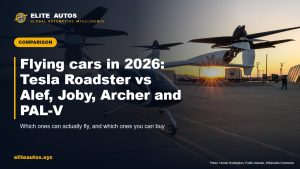 Flying cars in 2026: Tesla Roadster vs Alef Model A, Joby, Archer and PAL-V compared