Solid-state batteries are moving out of the laboratory and onto pilot production lines in 2026, but you still cannot buy a mass-market car with a true all-solid-state battery. Industry analyst TrendForce reported that the sector reached engineering validation in 2026, with Toyota, Honda, Nissan and Samsung SDI slightly ahead in small-scale pilot production, and Chinese leaders CATL, BYD and FAW advancing their own pilot lines. CATL, which holds about 40% of the global EV battery market, says it expects small-scale production of all-solid-state cells in 2027. Samsung SDI also targets 2027.
In this article
- What is a solid-state battery?
- Why it matters: the promised benefits
- All-solid, semi-solid and the naming fight
- Who is closest to production
- China: the scale race
- Japan and Korea: the quality race
- The start-ups: QuantumScape, Factorial, Solid Power, ProLogium
- The hard problems still unsolved
- Realistic timeline
- Should you wait for solid-state before buying an EV?
- Beyond cars: drones, eVTOLs and robots
- How a car battery works, in five simple steps
- A short history of car batteries
- The other new battery: sodium-ion
- What solid-state means for carmakers strategy
- What solid-state could mean for South Asia and the Gulf
- Glossary
- Company deep-dives
- Five signs a solid-state announcement is real
- November 2026 update: who is closest to mass production?
- Semi-solid vs all-solid: the important difference
- What buyers in Pakistan should do now
- How to read solid-state headlines
- Why solid-state matters: the three promised benefits
- The cost problem nobody can avoid
- Our verdict
- How it differs from today’s batteries
- The hurdles
- What to expect
- Semi-solid batteries are already on the road
- Common myths about solid-state batteries
- Frequently asked questions
Meanwhile, so-called semi-solid batteries are already in some cars, and China has just changed the rules on what companies are allowed to call “solid-state.” This guide explains, in plain language, what solid-state batteries are, why they matter, who is closest to production, what is real and what is hype, and what it means for anyone thinking about buying an electric car in the next few years.
SOLID-STATE BATTERIES: 2026 SNAPSHOT
ELITE AUTOS
What is a solid-state battery?
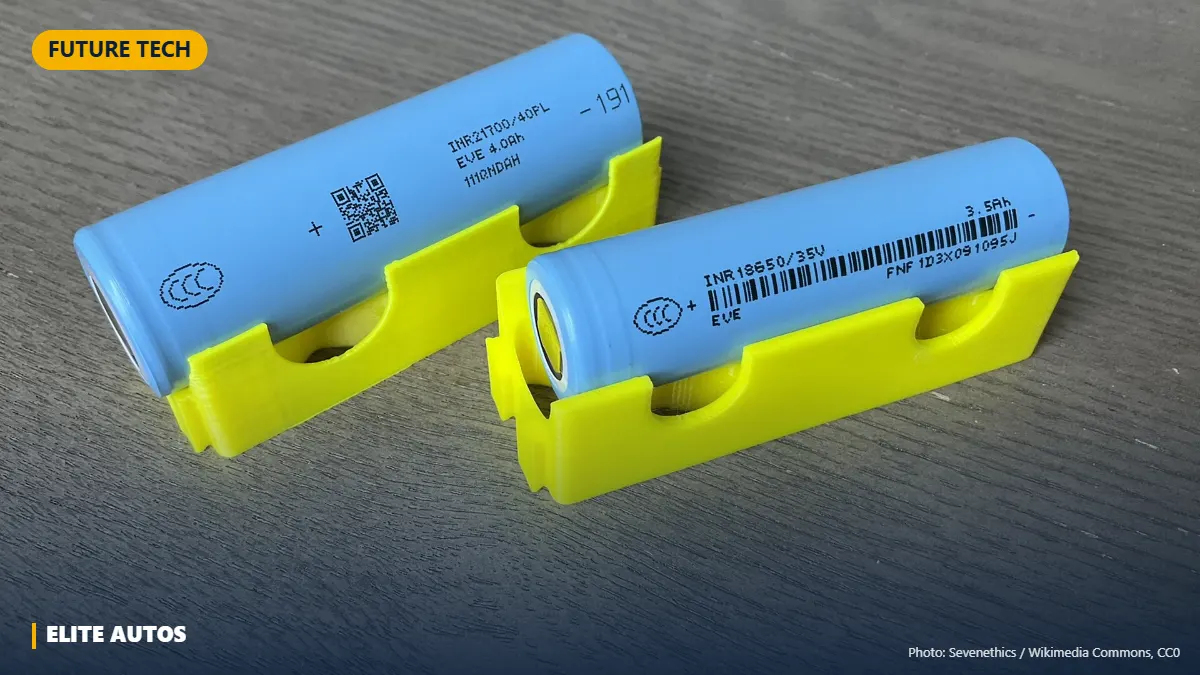
Every lithium battery has the same basic parts: a positive electrode (cathode), a negative electrode (anode), and a material between them that lets lithium ions move back and forth as the battery charges and discharges. In today batteries, that middle material, the electrolyte, is a liquid soaked into a thin plastic separator.
A solid-state battery replaces the liquid electrolyte with a solid material, usually a ceramic, a sulfide-based glass-like compound, or a polymer. That sounds like a small change, but it opens the door to different anode materials, especially pure lithium metal, which can store much more energy in the same space.
| Part | Today lithium-ion battery | Solid-state battery |
|---|---|---|
| Electrolyte | Flammable liquid | Solid: sulfide, oxide (ceramic) or polymer |
| Separator | Porous plastic film | The solid electrolyte itself, or a thin ceramic layer |
| Anode | Mostly graphite, sometimes with silicon | Can use lithium metal, or be anode-free |
| Main risk | Leaks and fire if damaged or overheated | Cracks, contact loss and manufacturing difficulty |
Why it matters: the promised benefits
- More range: higher energy density means more kilometres from a battery of the same weight. CATL has talked about 500 Wh/kg as a goal, roughly double many of today automotive cells.
- Faster charging: some designs could accept very high charging power without damaging the cells.
- Better safety: removing the flammable liquid lowers fire risk, although solid batteries still store a lot of energy and need careful design.
- Longer life: some chemistries promise more charge cycles before significant capacity loss.
- Lighter cars: more energy per kilogram could mean smaller packs, lighter cars and better efficiency.
All-solid, semi-solid and the naming fight
For years, companies used terms like “semi-solid,” “quasi-solid” and “solid-liquid hybrid” loosely, often to market batteries that still contained some liquid electrolyte. That changed in China in July 2026. A new national standard, GB/T for solid-state batteries for EVs, set a strict threshold: a battery must lose no more than 0.5% of its weight in a test to qualify as all-solid-state, and terms like “semi-solid,” “quasi-solid” and “pseudo-solid” are now prohibited in product marketing, SMM reported.
- All-solid-state (ASSB): no liquid electrolyte; the long-term goal.
- Semi-solid (now a banned marketing term in China): a mix of solid and liquid electrolyte; easier to make on existing lines, with smaller gains.
- Lithium-ion with solid additives: conventional cells with ceramic coatings or gel; sometimes marketed as solid-state, misleadingly.
Some semi-solid cars are already on the road. SAIC partner Qingtao supplies semi-solid cells for an MG model in China, SMM reported, and Nio has offered a semi-solid pack in the past. These deliver meaningful but modest improvements, not the leap promised by all-solid-state designs.
Who is closest to production
| Company | Country | Chemistry focus | Stated timing | Notes |
|---|---|---|---|---|
| CATL | China | Sulfide all-solid-state | Small-scale production in 2027 | 20 Ah cells; 500 Wh/kg in sight; 39.9% global EV battery share |
| BYD | China | All-solid-state | Pilot lines; 60 Ah cell stability on production line | Vertically integrated with its own cars |
| Samsung SDI | South Korea | Sulfide all-solid-state | Production target 2027 | Partnerships to validate cells |
| Toyota | Japan | Sulfide all-solid-state | Has slipped dates before; latest public target later this decade | Long-standing leader in patents |
| Honda, Nissan | Japan | All-solid-state | Pilot production | Small-scale pilot lines per TrendForce |
| QuantumScape | USA | Anode-free lithium metal, ceramic separator | Pilot line live; customer samples | Partner of Volkswagen PowerCo |
| Factorial | USA | Quasi-solid (semi-solid) and solid | Demonstration fleets | Designed to fit existing factories |
| ProLogium | Taiwan | All-inorganic solid | Pilot and planned plants | Also targeting Europe |

China: the scale race
China approach is classic: many companies, huge investment, fast iteration and government standards to steer the industry. SMM grouped Chinese players into tiers. In the first tier, with gigawatt-hour-scale capacity or large cells off the line, it placed BYD, CATL, Gotion, EVE, Dongfeng, Qingtao, WeLion, ProLogium and Xinjie. In the second tier, with pilots complete and ramping, it listed GAC, Changan, Geely, SVOLT, Ganfeng, Zenergy and Taland. Key milestones it flagged for the second half of 2026 included BYD 60 Ah cell stability on a production line, a 5 GWh pilot yield ramp at CATL and Gotion commissioning a 2 GWh line.
China advantage is the same as in today batteries: an enormous supply chain for materials, equipment and engineers. If any country can drive solid-state costs down quickly, it is China. The new standard, by banning vague marketing terms, also signals that regulators want a clear path to genuine all-solid-state products.
Japan and Korea: the quality race
Japanese companies, led by Toyota, have held many of the key patents for sulfide solid-state batteries for years. TrendForce reported that Japanese suppliers have already verified key automotive-grade performance measures and are speeding up the assessment of solid-state modules for vehicles. Toyota has been public about its ambition for solid-state, but it has also moved its timelines before, so outsiders treat its dates cautiously.
Korea Samsung SDI is targeting 2027 for all-solid-state production and has developed prototypes for automotive use. LG Energy Solution and SK On are also working on solid-state, while continuing to supply conventional cells. For Japanese and Korean battery makers, solid-state is a chance to regain an edge they lost to Chinese suppliers in mainstream lithium-ion.
The start-ups: QuantumScape, Factorial, Solid Power, ProLogium
Western start-ups attracted billions in investment with promises of breakthrough cells. Their progress is real but slower than early hype suggested. Battery Design summarised that QuantumScape and Samsung SDI have pilot lines running but not yet qualified production, and that demonstration fleets using some start-up cells are not the same as retail cars. Factorial architecture is semi-solid rather than fully solid. Solid Power focuses on supplying electrolyte materials and cells to partners rather than building cars itself. ProLogium, from Taiwan, is pushing an all-inorganic design and has announced plans for production in Europe.
The hard problems still unsolved
- Manufacturing at scale: solid electrolytes are hard to make thin, uniform and defect-free at high speed. A tiny flaw can cause failure.
- Interfaces: solid materials do not flow like liquids, so keeping good contact between layers as the battery swells and shrinks during charging is difficult; many designs need pressure applied to the cell stack.
- Dendrites: lithium metal can grow needle-like structures that short-circuit cells; solid electrolytes reduce but do not automatically eliminate this.
- Materials and cost: some sulfide electrolytes react with moisture and need dry-room manufacturing, adding cost.
- Temperature: some chemistries perform poorly in the cold or need heating to work well.
- Supply chain: the electrolyte supply chain for a 2027 vehicle launch is only being built now, Battery Design noted.
Realistic timeline
| Period | What is likely |
|---|---|
| 2026 | Engineering validation; pilot lines; semi-solid cells in a few cars; strict Chinese naming rules |
| 2027 | Small-scale all-solid-state production at CATL and Samsung SDI if targets hold; first limited vehicles |
| 2028-2029 | Low-volume premium cars and special applications; costs still high |
| 2030 and later | Possible wider adoption if costs fall and manufacturing yields improve |
The competitive landscape for 2027 volume production will be largely locked in by the end of 2026, SMM wrote. That means the next year of announcements matters: watch for named car models, customer contracts and production volumes, not just lab results.
Should you wait for solid-state before buying an EV?
For almost everyone, no. Today lithium-ion batteries, especially LFP cells, are cheaper and more durable than ever. Battery pack prices fell to record lows in 2025, and many EVs now offer 400 km or more of real-world range. If an EV suits your driving and you can charge at home or work, waiting several years for solid-state means missing years of lower running costs.
- Buy now if: you drive mostly in cities or on routes within a current EV range, and you have reliable charging.
- Consider a plug-in hybrid if: charging is unreliable where you live, as in many parts of South Asia, Africa and Latin America.
- Wait if: you need very long range in extreme climates, or you are buying a premium car you plan to keep for 10+ years and can delay purchase.
- Check the warranty: most EV batteries carry eight-year warranties, which covers the period before solid-state becomes mainstream.
In Pakistan, where BYD Atto 2 starts at Rs7.29 million and local assembly of BYD models begins in December 2026, the practical question is charging and load-shedding, not solid-state. Read our Pakistan car buying guide.
Beyond cars: drones, eVTOLs and robots
The first big markets for solid-state cells may not be cars at all. TrendForce found that companies including Samsung SDI, Maxell, Ilika, ProLogium and Factorial are targeting drones and eVTOL aircraft, microelectronics, construction machinery and humanoid robots, with several applications and orders already in place. These uses value safety and energy per kilogram and can pay higher prices, which helps manufacturers learn before tackling the mass car market. That links directly to the flying-car race: see our Tesla flying Roadster and flying cars guide.
How a car battery works, in five simple steps
If the chemistry sounds abstract, think of a battery as two parking lots for lithium ions connected by a road. Charging moves the ions from one lot to the other; driving lets them flow back, and that flow powers the motor.
- Step 1, charging: the charger pushes electrons into the anode through the external circuit, and lithium ions travel through the electrolyte to meet them and park in the anode.
- Step 2, storing: the ions sit in the anode, holding the energy, until you need it.
- Step 3, driving: when you press the accelerator, the ions travel back through the electrolyte to the cathode, while electrons flow through the motor circuit, doing useful work.
- Step 4, the road matters: the electrolyte is the road. A liquid road is easy to travel but can leak and burn. A solid road is safer and lets you build a bigger parking lot (a lithium metal anode), but it is harder to build without cracks and potholes.
- Step 5, wear and tear: every trip back and forth slightly damages the parking lots and the road, which is why batteries slowly lose capacity over years.
Solid-state batteries are, at heart, an attempt to build a better road. If the solid road works, engineers can use a far denser parking lot on the anode side, which is where most of the range gain comes from.
A short history of car batteries
| Era | Battery type | Where it was used |
|---|---|---|
| Early 1900s | Lead-acid | The first electric cars, before petrol engines won on range |
| 1990s | Nickel-metal hydride (NiMH) | Toyota Prius and other early hybrids, from 1997 |
| 2008 | Lithium-ion (laptop-style cells) | Original Tesla Roadster |
| 2010 | Lithium-ion (large-format cells) | Nissan Leaf, the first mass-market modern EV |
| 2020s | LFP comeback | Cheaper, longer-lasting cells adopted by BYD, Tesla and others |
| 2020s | Sodium-ion | Announced by CATL as a cheaper alternative without lithium |
| 2026 onward | Solid-state (pilot) | Engineering validation, pilot lines, limited vehicles from 2027 |
Each new chemistry took years to go from first announcement to mass use. Lithium-ion cells were sold in consumer electronics from the early 1990s but only became mainstream in cars about two decades later. That history is a useful guide for solid-state expectations.
The other new battery: sodium-ion
While solid-state gets the headlines, sodium-ion batteries may reach ordinary cars first. They replace lithium with sodium, which is abundant and cheap, and perform well in the cold. Their weakness is lower energy density, so they suit small city cars, two-wheelers and energy storage rather than long-range premium EVs. CATL and BYD have both developed sodium-ion cells, and some small Chinese cars and scooters already use them. For price-sensitive markets such as South Asia and Africa, sodium-ion could matter more in the next five years than solid-state.
What solid-state means for carmakers strategy
For carmakers, solid-state batteries are both an opportunity and a trap. The opportunity is a product leap: a premium EV with much longer range, faster charging and a safety story would stand out. The trap is timing. A company that waits too long for solid-state may lose market share to rivals selling good-enough lithium-ion cars today. A company that bets too early may spend billions on a technology that is not ready.
- Toyota combines hybrids today with a long-term solid-state bet, aiming to leapfrog rivals in EVs later.
- Volkswagen works with QuantumScape through its battery unit PowerCo.
- Chinese carmakers such as BYD, GAC, Changan and Geely develop their own cells or work closely with domestic suppliers, keeping control of costs.
- Hyundai, Honda and Nissan run their own pilot programmes or partnerships with Korean and Japanese suppliers.
The likely outcome is that the first solid-state cars will be expensive, low-volume flagships, in the way early hybrids and EVs were. Mass-market cars will follow only once costs approach those of LFP cells.
What solid-state could mean for South Asia and the Gulf
Hot climates are hard on today batteries, which degrade faster at high temperatures and need active cooling. Solid-state cells could, in principle, cope better with heat and reduce fire risk, which would be valuable in Pakistan, India and the Gulf. But these markets are also price-sensitive and will likely get solid-state cars last, after China, Japan, Korea, Europe and North America. In the meantime, LFP cells with good thermal management, and plug-in hybrids where charging is unreliable, are the practical choices.
Glossary
- Energy density (Wh/kg): how much energy a battery stores per kilogram; higher means more range for the same weight.
- Electrolyte: the material that lets lithium ions move between the electrodes.
- Sulfide, oxide, polymer: the three main families of solid electrolytes.
- Anode-free: a design where the lithium anode forms during the first charge, saving weight and space.
- Dendrite: a needle-like lithium growth that can short-circuit a cell.
- TRL (technology readiness level): a 1 to 9 scale of maturity; 5 to 6 means validated in relevant conditions.
- LFP: lithium iron phosphate, a cheaper, durable chemistry now common in EVs.
- Pilot line: a small production line used to prove a process before full-scale manufacturing.
Company deep-dives
CATL
Contemporary Amperex Technology, better known as CATL, is the world largest EV battery maker, with a 39.9% share of the global market in the first half of 2026 according to SNE Research data reported by Electrek. That scale gives it something no start-up has: the cash, the factories and the customer relationships to bring a new chemistry to market once it works. CATL says it continues to invest heavily in all-solid-state batteries and expects small-scale production in 2027. It has shown 20 Ah solid-state cells and talks about energy density of around 500 Wh/kg as a target. CATL also runs a broad portfolio, from LFP and nickel-rich cells to sodium-ion and condensed batteries, which means it does not need solid-state to succeed quickly. That patience is a strength: it can move when the technology is ready rather than when marketing demands it.
BYD
BYD began as a battery company in 1995 before it ever built a car, and today it makes its own cells for its own vehicles through its FinDreams unit. Its Blade LFP battery, a long, thin cell format that improves safety and packaging, helped make BYD the world largest new energy vehicle maker. On solid-state, SMM placed BYD in the first tier of Chinese companies, with a key 2026 milestone being the stability of 60 Ah cells on a production line. Because BYD controls both the battery and the car, it can design a vehicle around a new cell faster than companies that buy cells from suppliers. Expect BYD to use any early solid-state cells first in premium models from Denza or Yangwang rather than in budget cars.
Toyota
Toyota has worked on sulfide solid-state batteries for well over a decade and holds a large share of the relevant patents. It has also learned the hard way how difficult the step to mass production is, and outside analysts note that it has moved its solid-state dates before. Toyota strategy is unusual: it sells millions of hybrids today, which are profitable and need only small batteries, while investing in solid-state as a way to leap ahead in full EVs later. TrendForce counted Toyota among the companies slightly ahead in small-scale pilot production in 2026. If Toyota can launch a solid-state car before the end of the decade, it would be a major comeback story in EVs, where it has lagged Tesla and BYD.
Samsung SDI
Samsung SDI is one of Korea big three battery makers and has set 2027 as its target for all-solid-state production. It works with partners to validate sulfide cells and has shown prototypes aimed at premium vehicles. Korea battery industry lost ground to China in mainstream cells and is now pushing hard on next-generation chemistries. Samsung SDI is also exploring uses outside cars, such as robotics and devices, where higher prices make early solid-state cells easier to sell.
QuantumScape
QuantumScape, backed by Volkswagen, uses an anode-free lithium metal design with a ceramic separator. The idea is elegant: there is no anode material at the start, and lithium plates onto the current collector during charging, saving weight and space. The company has a pilot line running and has shipped sample cells to customers, but Battery Design notes that its production is not yet qualified for vehicles. Its partnership with Volkswagen battery company PowerCo is designed to license the technology for mass production rather than build every cell itself.
Factorial, Solid Power and ProLogium
Factorial Energy has partnerships with several major carmakers and has focused on a quasi-solid design that can be built on modified existing production lines, lowering the cost of adoption. Solid Power, another US company, concentrates on making sulfide electrolyte materials and supplying cells to partners such as BMW and Ford for testing. ProLogium from Taiwan uses an all-inorganic approach and has announced plans for a factory in France. All three are important, but none has yet proven high-volume automotive production.
Five signs a solid-state announcement is real
- A named car model and launch date, not just a concept or “future vehicle.”
- Production volumes in gigawatt-hours, not single cells or demonstration fleets.
- Third-party test data on cycle life, cold-weather performance and safety.
- A price or cost target close to today lithium-ion cells.
- A warranty for the battery equal to or better than current EVs.
Use this checklist whenever you see a headline claiming a battery breakthrough. Most announcements meet one or two of these tests. A genuine shift will meet all five.
November 2026 update: who is closest to mass production?
Solid-state batteries have moved from laboratory promises to pilot lines, but the timelines keep shifting. The clearest way to understand the race is to look at what each major player has actually confirmed, rather than headline claims about range or charging time.
CATL: small batches in 2027
CATL, the world’s largest battery maker, reaffirmed in an investor response on 27 October 2026 that it is targeting small-batch production of solid-state cells in 2027. It first reported a 20 Ah solid-state prototype in 2024 and is developing a sulfide-based electrolyte, the same broad chemistry route chosen by Toyota.
Sunwoda: a different chemistry
Sunwoda is taking a polymer-composite approach and is testing cells with carmakers. Its subsidiary SEVB has connected a solid-state pilot line with a design capacity of 0.2 GWh a year, tiny compared with conventional battery factories, which shows how early the industry still is.
Toyota: Lexus first, sulfide route
Toyota’s solid-state battery received production approval in Japan on 7 October 2025, and the company is working with Sumitomo Metal Mining on cathode materials and with Idemitsu Kosan on solid electrolytes. Reports from the Chinese industry information service SMM say Toyota plans a 10 GWh solid-state factory in Japan, with first use in high-end Lexus models and a goal of reducing solid-state costs to within 1.5 times those of liquid lithium-ion batteries by 2030. InsideEVs notes that Toyota has priority to receive the key cathode material from 2028, so large volumes before then are unlikely.
Samsung SDI, BMW and Solid Power
Samsung SDI has signed an agreement with BMW and Solid Power for a solid-state battery verification project: Solid Power supplies the electrolyte, Samsung SDI builds the cells and BMW develops the modules and packs. Nissan is also developing solid-state technology, including lithium-sulfur cells designed to cut cost.
| Company | Chemistry route | Latest confirmed milestone |
|---|---|---|
| CATL | Sulfide | Small-batch production target 2027 (reaffirmed Oct 2026) |
| Toyota | Sulfide | Production approval in Japan, Oct 2025; Lexus first |
| Sunwoda / SEVB | Polymer composite | 0.2 GWh pilot line connected |
| Samsung SDI + BMW + Solid Power | Sulfide electrolyte from Solid Power | Verification project agreed |
| Nissan | Sulfur-based materials | Development to reduce cost |
Semi-solid vs all-solid: the important difference
Many cars already advertised as having “solid-state” batteries actually use semi-solid or hybrid solid-liquid cells, which keep some liquid electrolyte. These are easier to make and are already in production in China, for example in some IM Motor models. SMM projects that semi-solid batteries could reach about 160 GWh of shipments by 2028, compared with only about 13.5 GWh for true all-solid-state batteries. For buyers, that means the first “solid-state” cars on sale will mostly be semi-solid, with modest gains rather than the dramatic 1,000 km-plus ranges often promised.
Solid-state technology is also spreading beyond cars. In June 2026 Helios Horizon reported the world’s first crewed fixed-wing flight powered by solid-state batteries, a sign that the high energy density and safety benefits are attractive for aviation, which could compete with carmakers for early production volumes.
What buyers in Pakistan should do now
Do not wait for solid-state batteries before buying an electric car or hybrid. Even optimistic plans put all-solid-state cells in expensive luxury models first, from 2027 at the earliest, and in affordable cars around 2030 or later. Cars sold in Pakistan today use lithium iron phosphate or nickel-based lithium-ion batteries, and the most useful things to check are the battery warranty, local service support and how the car charges on Pakistani home electricity. If you are buying a hybrid such as a Corolla Cross or a plug-in hybrid from BYD, solid-state technology will not change its value in the next few years.
How to read solid-state headlines
- Check the cell size: a lab cell of a few amp-hours is very different from a car-sized cell.
- Check the word “semi”: semi-solid batteries are useful but not the full breakthrough.
- Check the volume: a pilot line of 0.2 GWh can supply only a few thousand cars a year.
- Check the car: a battery is only commercial when it is in a car customers can actually buy.
Why solid-state matters: the three promised benefits
1. More energy in the same space. In a normal lithium-ion battery, ions move through a liquid electrolyte. A solid electrolyte can allow the use of a lithium-metal anode, which stores much more energy than today’s graphite anodes. That is where claims of 50% to 100% more range for the same battery size come from. In practice, the first products will deliver smaller gains, because carmakers will use the extra density partly to make packs smaller and cheaper rather than only to add range.
2. Safer batteries. Liquid electrolytes are flammable, which is why battery fires, although rare, are difficult to put out. Solid electrolytes are much less likely to catch fire, which could reduce the need for heavy protective structures and cooling systems. That matters for hot countries such as Pakistan and the Gulf, where battery temperature management is a constant challenge.
3. Faster charging. Some solid-state designs can accept higher charging currents without forming the lithium “dendrites” that damage cells. Toyota and others have talked about charging from 10% to 80% in around ten minutes. Whether that is possible in daily use depends as much on chargers and grid capacity as on the battery itself.
The cost problem nobody can avoid
The biggest barrier is cost. Solid electrolytes, especially sulfide materials, are expensive to make and sensitive to moisture, so factories need extremely dry rooms. Industry estimates suggest early solid-state cells cost several times more than conventional cells, which is why Toyota’s own goal is only to bring the cost down to about one and a half times that of liquid batteries by 2030. Until that gap closes, solid-state cells will stay in luxury cars, performance models and aircraft, while lithium iron phosphate batteries keep getting cheaper and dominate affordable electric cars.
This is also why many experts expect a long transition. Semi-solid cells will bridge the gap for several years, and conventional lithium-ion technology will continue to improve in parallel. The likely outcome is not a sudden revolution but a gradual rise in solid-state share through the 2030s.
Our verdict
Solid-state batteries are real, and 2027 is likely to be the first year when small numbers reach paying customers in premium cars from Japanese and Chinese makers. But they will not make today’s electric cars obsolete. For the rest of this decade, the battery in an affordable electric car or hybrid will almost certainly be lithium iron phosphate or nickel-based lithium-ion, improving step by step in price, charging speed and lifespan.
The companies to watch are those that can prove three things at once: consistent quality across millions of cells, a cost close to conventional batteries and a supply chain for solid electrolytes that does not depend on a single supplier. When those three boxes are ticked, solid-state will move from headline to showroom.
Elite Autos will keep tracking pilot lines, carmaker test programmes and the first customer cars, and we will update this guide each time a company moves from prototype cells to verified production.
If you have a question about a specific battery announcement, send it to us and we will check it against company filings.
How it differs from today’s batteries
| Feature | Lithium-ion (liquid electrolyte) | Solid-state |
|---|---|---|
| Electrolyte | Liquid | Solid (ceramic, sulfide or polymer) |
| Energy density | Good | Potentially much higher |
| Fire risk | Low but present | Lower |
| Fast charging | Limited by heat and lithium plating | Potentially faster |
| Cost today | Mature and falling | High; mostly pilot scale |
The hurdles
- Manufacturing: Solid electrolytes are hard to produce in thin, defect-free layers at high volume.
- Interfaces: Keeping solid layers in contact as the cell swells and shrinks during charging is difficult.
- Dendrites: Metal spikes can still form and short a cell under some conditions.
- Cost: New materials and factories must compete with lithium-ion prices that keep falling.
What to expect
Expect the first solid-state cells in premium or limited-run models before mass-market cars. Meanwhile, cheaper chemistries such as LFP and sodium-ion are moving faster into affordable EVs.
Semi-solid batteries are already on the road
Before full solid-state arrives, Chinese carmakers sell “semi-solid” batteries, which use less liquid electrolyte. NIO has offered a 150 kWh semi-solid pack, and SAIC’s IM Motors has fitted semi-solid cells. These bring modest gains in energy density and safety rather than the big leap promised by true solid-state cells.
Common myths about solid-state batteries
- “They will double range overnight.” Early cells promise gains, but first production cars are likely to bring smaller, gradual improvements.
- “They are completely fireproof.” They are safer in principle, but no battery is risk-free.
- “Waiting for solid-state makes sense.” For most buyers, no: today’s LFP and NMC packs already last well beyond typical ownership periods.
Frequently asked questions
Can I buy a car with a solid-state battery in 2026?
Not a mass-market car with a true all-solid-state battery. Some cars in China use semi-solid cells, which still contain some liquid electrolyte.
When will solid-state batteries be in cars?
CATL and Samsung SDI target small-scale production in 2027. Wider adoption is more likely around 2030 if costs fall.
Are solid-state batteries safer?
They remove the flammable liquid electrolyte, which lowers fire risk, but they still store a lot of energy and need careful design.
How much more range will solid-state give?
Targets such as 500 Wh/kg would roughly double the energy density of many current automotive cells, but real-world gains will depend on cost and design.
What is a semi-solid battery?
A battery that mixes solid and liquid electrolytes. China banned the term “semi-solid” in product marketing under a new standard in July 2026.
Who leads solid-state battery development?
Toyota, Honda, Nissan and Samsung SDI are slightly ahead in pilot production according to TrendForce; CATL and BYD lead China scale-up.
Should I wait for solid-state before buying an EV?
For most buyers, no. Today lithium-ion batteries are cheaper and more durable than ever, and come with long warranties.
Sources
- TrendForce via iConnect007: ASSBs enter engineering validation
- Electrek: CATL 20 Ah solid-state cells, 500 Wh/kg in sight
- EEPower: solid-state batteries race to mass production
- Battery Design: solid-state production timelines
- SMM: solid-state battery competitive landscape 2026
This article was prepared with AI assistance and checked against the sources listed. Read our AI use policy and corrections policy.
Related on Elite Autos
 Tesla FSD v15: release date, Hardware 4 requirement and what changes
 BYD Flash Charging network 2026: 10,000 megawatt stations, 9-minute charging and overseas plans
 Can you own a flying car in Pakistan or the UAE? Laws, airspace and Dubai’s air taxis explained
 Flying cars in 2026: Tesla Roadster vs Alef Model A, Joby, Archer and PAL-V compared