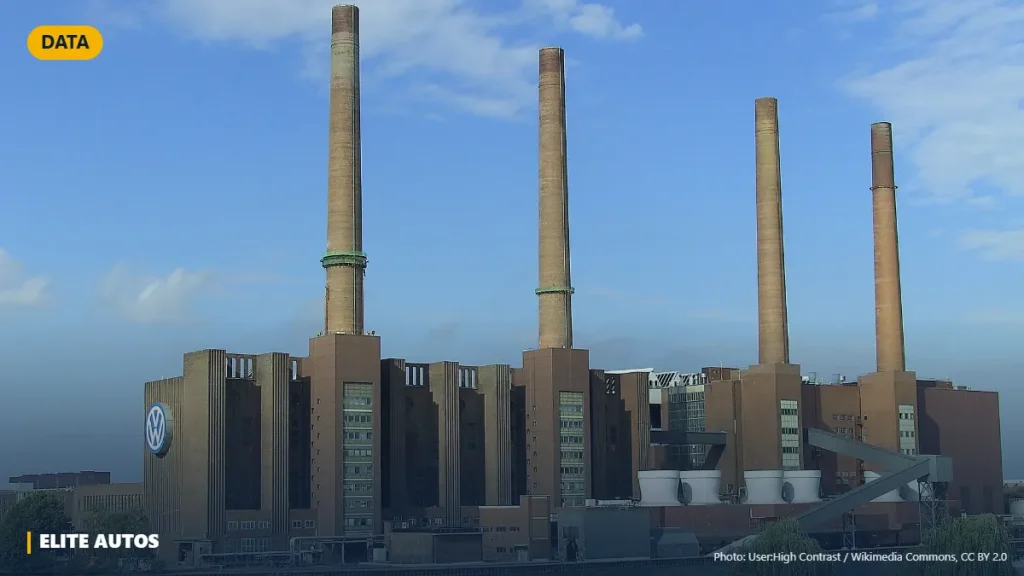
Germany is the world biggest car exporter by value ($176.6 billion in 2025) and the second-largest producer of electric cars after China. Domestic passenger car production was 4.15 million units in 2025, up 2%, and four in ten cars built were electrically powered, the German auto association VDA said.
In this article
- Key numbers
- Demand at home
- The pressure points
- Our read
- October 2026: electric cars overtake combustion
- Chinese brands are gaining
- The paradox: strong EV sales, weak production
- Key takeaways
- What it means for Pakistan
- Our view
- What to watch next
- Germany’s big carmakers at a glance
- Bottom line
- Frequently asked questions
Key numbers
| Metric | Value | Source |
|---|---|---|
| Passenger cars built, 2025 | 4.15 million (+2%) | VDA |
| Electric share of production, 2025 | 40% (record) | VDA |
| Cars built, Jan-Sep 2026 | 3.03 million (-4% YoY, -15% vs 2019) | VDA via Al Majalla |
| VDA 2026 production forecast | 4.11 million (-1%) | VDA |
| Electric cars to be built in 2026 | 1.76 million (+6%) | VDA |
| Foreign production by German brands, 2026 forecast | 9.2 million (+1%) | VDA |
Demand at home
A new EV purchase subsidy has been available since May 19, 2026, and German new-car registrations rose 16% in June to 296,378, VDA reported. The VDA had forecast close to one million electric car registrations in 2026, about 17% more than in 2025.
The pressure points
- High energy and labour costs compared with China and the US.
- Chinese EV competition at home and in China, once German brands most profitable market.
- Supplier restructuring: Schaeffler plans four German plant closures.
- Ford ended vehicle production at Saarlouis in late 2025.
Our read
Germany is building more electric cars than ever, but fewer cars overall than before the pandemic. More of its brands production is moving abroad (9.2 million vehicles outside Germany against about 4.1 million at home). The EU softer 2035 CO2 rules give German makers more time for combustion engines, but they do not fix the cost gap.
October 2026: electric cars overtake combustion
Germany registered 254,492 new cars in October 2026, up 1.7%. Battery-electric cars rose 79.5% to 94,086 units, a record 37% share, and together with plug-in hybrids electrified cars took 48.2% of the market (The Star/Xinhua). Petrol registrations fell 40.5% to a 15.1% share and diesel to 9.4%, so pure combustion cars made up just 24.5% of sales, less than electric cars alone (Electrek).
| Powertrain (October 2026) | Share of new registrations |
|---|---|
| Battery-electric | 37.0% |
| Hybrid (non-plug-in) | 26.5% |
| Petrol | 15.1% |
| Plug-in hybrid | 11.2% |
| Diesel | 9.4% |
In January–October, Germany registered 698,230 battery-electric cars, up 60.7%, already beating the VDA’s full-year forecast of about 693,000 with two months to go (The Cool Down). The new subsidy targets private buyers, and private registrations rose 20.6% in October while company registrations fell.
Chinese brands are gaining
Chinese brands logged about 16,000 registrations in October, a 6.3% share, led by BYD with 5,173 and Leapmotor with 3,661 (ChinaEVHome). Volkswagen group brands such as VW, Audi and Skoda fell year on year, while Tesla, Leapmotor and Xpeng grew strongly from a small base. That is a warning sign for German carmakers: their home market is switching to EVs quickly, but foreign brands are capturing a growing share of that switch.
The paradox: strong EV sales, weak production
Germany is selling more EVs than ever, but domestic car production is still about 15% below 2019 and exports are falling. High energy and labour costs, weak demand in China, U.S. tariffs and competition from Chinese EVs are all squeezing German factories. That is why carmakers and suppliers such as Volkswagen and Schaeffler are cutting jobs even as EV demand at home booms. Read our report on Europe’s auto restructuring for details.
Key takeaways
- Germany built 4.15 million cars in 2025, 40% of them electrified.
- EVs took a record 37% of new registrations in October 2026.
- Petrol and diesel combined fell to under a quarter of sales.
- Chinese brands reached 6.3% of the market; domestic production remains well below 2019.
What it means for Pakistan
German brands such as Mercedes-Benz, BMW, Audi and Volkswagen sell in Pakistan mainly as expensive imports. As Germany’s own market turns electric, these brands are shifting their line-ups toward EVs and plug-in hybrids, which will also shape what Pakistani importers can buy. With Pakistan’s new policy cutting GST on EVs to 1%, imported German EVs such as the BMW iX or Mercedes EQ models may become more competitive against large petrol SUVs.
Our view
Germany is proving that subsidies can quickly move buyers to electric cars, but the subsidy does not decide who builds those cars. If Chinese and American brands keep taking a larger share of German EV sales, the jobs lost in combustion-engine production will not come back in EV production. The next two years are critical for Volkswagen, BMW and Mercedes-Benz to launch affordable EVs that can win back buyers at home.
What to watch next
- Monthly KBA registration data for November and December.
- Whether the EV subsidy budget lasts through 2027.
- VDA production figures and export trends.
- Chinese brands’ market share in Germany.
Germany’s big carmakers at a glance
- Volkswagen Group: Europe’s largest carmaker, cutting up to 100,000 jobs.
- BMW: cut its 2026 profit outlook amid restructuring costs.
- Mercedes-Benz: focused on luxury and high-margin models.
- Suppliers Bosch, ZF, Continental and Schaeffler: all restructuring.
Bottom line
Germany has become one of Europe’s fastest-switching EV markets, but its car industry is still shrinking. Winning back buyers with affordable German-built EVs is the industry’s biggest challenge.
Elite Autos updates this country report every month when the KBA and VDA publish new registration and production data. See our Data section for more country reports and market rankings from around the world.
Data is checked against official sources.
Frequently asked questions
How many cars does Germany produce?
4.15 million passenger cars in 2025; VDA expects 4.11 million in 2026.
Is Germany the second-largest EV producer?
Yes. VDA and Germany Trade and Invest say Germany built more EVs than any country except China in 2025.
Sources
- VDA: passenger car production 2025
- VDA: production and market January 2026 (40% electric)
- VDA: June 2026 market
- Al Majalla: uphill road for Germany carmakers
- GTAI: Germany is world second-largest EV maker
This article was prepared with AI assistance and checked against the sources listed. Read our AI use policy and corrections policy.