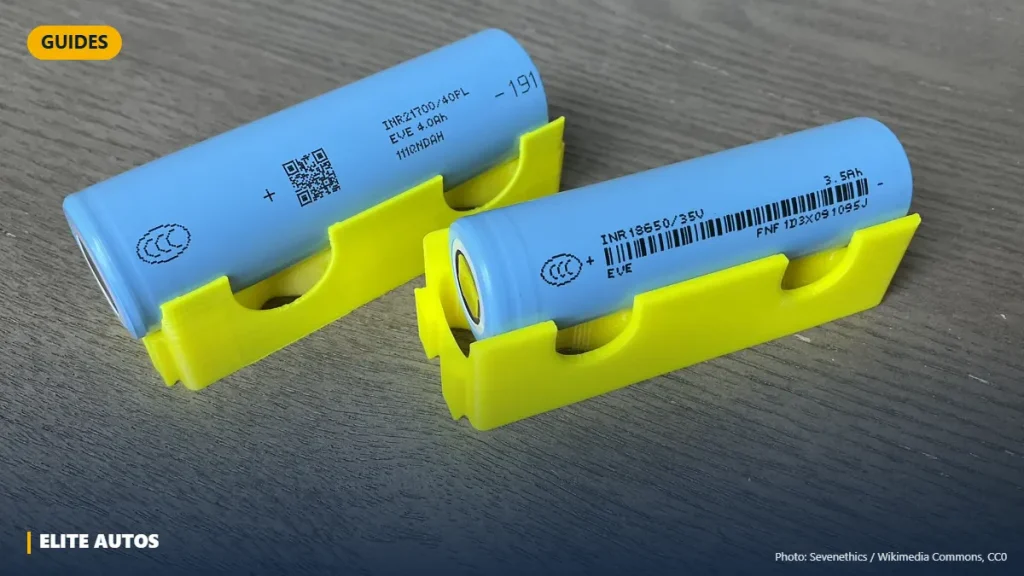
Quick answer: LFP (lithium iron phosphate) batteries are cheaper, very durable and thermally stable, but store less energy for their weight. NMC (nickel manganese cobalt) batteries pack more energy, so cars go further, but cost more. More carmakers are switching to LFP for affordable models and commercial vehicles; Mercedes, for example, plans to move its eCitaro electric bus fully to LFP from 2028 (Latest EV News).
In this article
Side by side
| Feature | LFP | NMC |
|---|---|---|
| Energy density | Lower | Higher |
| Cost | Lower | Higher |
| Cycle life | Longer | Shorter |
| Thermal stability | Very stable | Stable, but more sensitive to heat |
| Cold-weather performance | Weaker | Better |
| Daily charging advice | Many makers allow 100% | Many makers suggest about 80% |
What it means for you
- Range: For the same size pack, NMC usually gives more range.
- Price: LFP helps bring EV prices down, which is why it is common in entry-level models.
- Ownership: LFP’s long life suits high-mileage drivers, taxis and fleets.
- Winter: LFP cars can lose more range and charge more slowly in the cold, so battery pre-heating matters.
Charging habits: LFP vs NMC
| Habit | LFP | NMC / NCA |
|---|---|---|
| Daily charge limit | Charging to 100% regularly is generally fine; many carmakers recommend it at least weekly so the car can calibrate its range estimate | Most carmakers recommend about 80–90% for daily use and 100% only before long trips |
| Leaving the car at 100% | Less harmful | Avoid for long periods; high charge speeds up ageing |
| DC fast charging | Tolerates it well | Fine, but frequent fast charging in heat adds wear |
| Cold weather | Loses more range and charges slower when cold | Copes better with cold |
Which chemistry suits hot countries?
In hot climates such as Pakistan, the Gulf and much of India, LFP has two advantages: it is more thermally stable, so it is less prone to overheating, and it usually lasts more charge cycles. Its weaker cold-weather performance rarely matters there. NMC makes more sense where range per kilogram matters most, such as performance cars, long-range models and very cold countries.
Which cars use which battery?
- LFP: most BYD models (Blade battery), standard-range Tesla Model 3 and Model Y in many markets, and many small Chinese EVs such as the BYD Seagull/Dolphin Surf.
- NMC/NCA: many long-range and premium EVs from European, Korean and US brands, where higher energy density gives more range from the same weight.
- Both: several carmakers now offer LFP on base versions and NMC on long-range versions of the same model, so check the exact variant.
Lifespan and warranty
Most EV makers give battery warranties of about 8 years and 160,000 km, usually promising that capacity will stay above about 70%. LFP packs often exceed this because they tolerate more cycles. For a used EV, ask for a battery health (state of health) report; see our used EV battery check guide.
Common myths about LFP and NMC
- “LFP batteries are low quality.” No: LFP is a different trade-off, not a cheaper copy. It gives up some range for longer life and better heat stability.
- “You should never charge to 100%.” That advice applies mainly to NMC. Many LFP cars are designed to be charged to 100% regularly.
- “NMC batteries catch fire easily.” EV fires are rare, and both chemistries are protected by battery management systems; LFP simply has a wider safety margin.
Glossary
- LFP
- Lithium iron phosphate, a cathode chemistry without nickel or cobalt.
- NMC / NCA
- Nickel manganese cobalt / nickel cobalt aluminium cathodes with higher energy density.
- Energy density
- How much energy a battery stores per kilogram (Wh/kg); higher means more range for the same weight.
- Cycle life
- How many full charge and discharge cycles a battery lasts before losing a set share of capacity.
- Thermal runaway
- A chain reaction of overheating inside a cell, which battery systems are designed to prevent.
Elite Autos tip
Check your car’s manual for its charging advice. If it has an LFP pack, the maker may recommend charging to 100% regularly so the range estimate stays accurate.
Frequently asked questions
Which battery is better, LFP or NMC?
Neither is better for everyone: LFP is cheaper and longer-lasting, NMC gives more range.
How do I know which battery my EV has?
Check the specification sheet or ask the dealer; many makers list the chemistry by version.
Are there other battery types coming?
Yes. Sodium-ion and solid-state batteries are in development.
Sources
Related: Sodium-ion batteries explained · Solid-state batteries explained
This article was prepared with AI assistance and checked against the sources listed. Read our AI Use Policy and Corrections Policy.
Related on Elite Autos
 API SQ and ILSAC GF-7 explained: the new engine oil standards
 Do electric cars need oil? EV fluids and maintenance explained
 Prince of Monaco car collection: tickets, hours and the cars of Rainier III and Princess Grace
 Emirates National Auto Museum guide: tickets, hours, location and the Rainbow Sheikh’s cars
Pingback: Sodium-ion batteries: the cheaper chemistry coming to EVs - Elite Autos