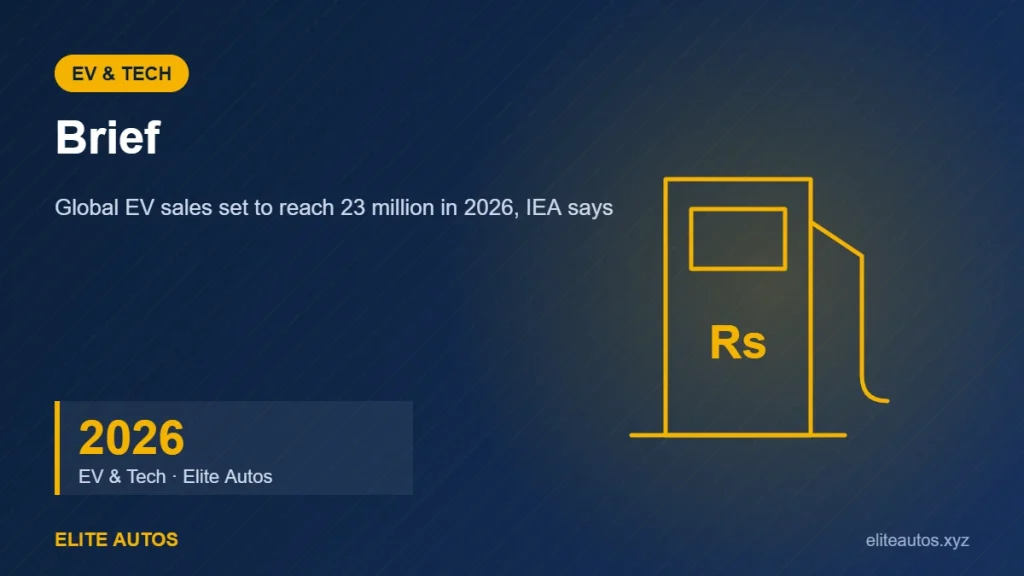
Quick answer: The International Energy Agency expects global electric car sales to reach 23 million in 2026, close to 30% of all cars sold, after more than 20 million in 2025 (IEA).
In this article
The numbers
| Measure | Figure | Source |
|---|---|---|
| EV sales, 2025 | More than 20 million (+20%) | IEA |
| EV share of new cars, 2025 | About one in four | IEA |
| EV sales forecast, 2026 | 23 million | IEA |
| EV share forecast, 2026 | Close to 30% | IEA |
Why it matters
Even with North America slowing, global EV growth continues, led by China, Europe and emerging markets.
What the IEA report says
The International Energy Agency’s Global EV Outlook 2026, published in May, found that electric car sales grew 20% in 2025 to more than 20 million, so one in four new cars sold worldwide was electric. It expects 23 million sales in 2026, close to 30% of the global market (IEA). Chinese carmakers supplied 60% of global electric car sales in 2025, while European and North American carmakers each supplied about 15% (IEA executive summary).
| Region | 2025 picture | 2026 outlook |
|---|---|---|
| World | 20+ million EVs, about 25% share | 23 million, close to 30% |
| China | Largest market; policy changes slowed early 2026 | Domestic demand weaker, exports strong |
| Europe | 4.2 million, about 28% share | Around +20%, one in three cars electric |
| United States | Just under 10% share | Lower after tax credits ended |
| India and emerging markets | India EV sales +30% | Fast growth from a small base |
The energy crisis changed the story
The 2026 outlook was shaped by the energy crisis linked to the war in the Middle East. High oil prices made running costs a bigger part of car-buying decisions, and the IEA said that helps EVs. At the same time, policy changes in China and the end of U.S. federal tax credits caused global EV sales to fall 8% in the first quarter of 2026 compared with a year earlier. The dip hid strong growth elsewhere: nearly 90 countries saw EV sales rise in March 2026, and about 30 set monthly records (BusinessDay).
The long-term view
Even without new policies, the IEA expects the global electric car fleet to grow from nearly 80 million today to as many as 510 million by 2035 (The Standard/Reuters). Falling battery prices and growing cost competitiveness are the main drivers. Electric trucks are also growing fast: global sales more than doubled in 2025, and electric models were nearly one in ten trucks sold worldwide (Engineering News).
Is the forecast on track?
Data since May suggests a mixed picture. Europe is running ahead: Germany’s battery-electric share hit a record 37% in October. China’s total NEV sales reached a record 1.94 million in October, but only because exports jumped while home sales fell. The United States is weaker after tax credits ended. Overall, 23 million looks achievable, but the regional mix is shifting from China’s home market toward Europe and emerging markets.
Key takeaways
- Global EV sales topped 20 million in 2025, one in four new cars.
- The IEA forecasts 23 million in 2026, close to 30% of the market.
- Chinese carmakers supply 60% of the world’s electric cars.
- High oil prices from the Middle East crisis are helping EV demand.
What it means for Pakistan and the Gulf
Pakistan is still at the very start of the EV transition. Electric cars are a tiny share of new sales, charging networks are limited to a few cities, and most EVs are imported from China. But the new auto policy cuts sales tax on battery-electric cars to 1% and offers toll exemptions for new energy vehicles, while high petrol prices make running costs a stronger argument for electric. The Gulf is moving faster: the UAE has one of the highest EV shares in the Middle East and an expanding public charging network, and Saudi Arabia is building local EV production. For buyers in both regions, the global shift means more EV choice, lower prices and better resale prospects over the next few years. See our fuel price tracker to compare running costs.
Our view: the weak points in the forecast
The forecast depends heavily on China, which still makes up more than half of global EV sales. If China’s domestic market keeps shrinking and other countries raise tariffs on Chinese EVs, global growth could fall short. A sharp drop in oil prices would also weaken the running-cost advantage that helped EVs in 2026. On the other hand, battery prices keep falling, and cheaper EVs are arriving in emerging markets, which could push sales higher than expected. On balance, the 23 million target looks realistic, but the share of growth coming from outside China will need to rise.
What to watch next
- Full-year 2026 EV sales data in early 2027.
- The IEA’s next Global EV Outlook, usually published in spring.
- EV sales trends in India, South-East Asia and Latin America.
- U.S. policy changes affecting EV demand.
Bottom line
Electric cars are now a mainstream global product, with close to three in ten new cars expected to be electric in 2026. The pace varies sharply by region, and China’s exports are now as important to the story as its home market.
Elite Autos updates this brief when new global EV data is released. See our EV & Tech section for more analysis.
Battery technology is the key to the next phase of EV growth. Read our solid-state battery guide to see what could make EVs cheaper and longer-range after 2027. Updated November 2026.
All figures are checked against IEA releases.
Frequently asked questions
How many EVs will be sold in 2026?
About 23 million, according to the IEA.
What share of new cars will be electric in 2026?
Close to 30%, the IEA forecasts.
Related: Global EV sales by region · All briefs
This article was prepared with AI assistance and checked against the sources listed. Read our AI Use Policy and Corrections Policy.