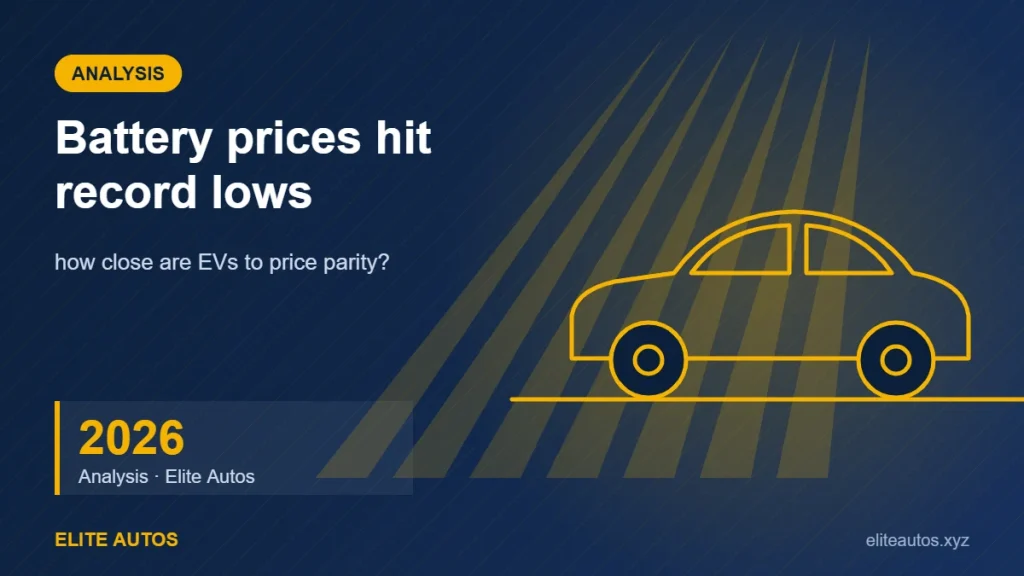
Quick answer: Lithium-ion battery pack prices fell 8% to a record low of $108 per kWh in 2025, and battery-EV packs averaged $99/kWh, according to BloombergNEF (BNEF; Energy-Storage.news). In China, EVs have already reached price parity with petrol cars in almost every segment, but packs in North America and Europe cost 44% and 56% more (BNEF).
In this article
Battery prices in numbers
| Measure | 2025 | Source |
|---|---|---|
| Average pack price (all uses) | $108/kWh (−8%) | BNEF |
| Battery-EV pack price | $99/kWh | Energy-Storage.news |
| Average cell price | $74/kWh | Energy-Storage.news |
| China average pack price | $84/kWh (−13%) | BNEF |
| North America / Europe vs China | +44% / +56% | BNEF |
| Change since 2010 | −93% (from about $1,474/kWh) | Energy-Storage.news |
Why prices keep falling
- Factory overcapacity and fierce competition among Chinese cell makers.
- The shift to cheaper lithium iron phosphate (LFP) chemistry.
- New chemistries such as sodium-ion starting to come online (BNEF).
What it means for car buyers
- China: EVs already cost the same as or less than petrol cars.
- Europe and the US: higher local battery costs keep EVs dearer; cheaper imported cells face tariffs.
- Emerging markets: cheap Chinese EVs bring parity closer in Thailand, Brazil and the Gulf.
Elite Autos analysis
The technology to make EVs as cheap as petrol cars exists today; the barrier outside China is local cost and trade policy. If Europe and North America cannot close the battery cost gap, Chinese brands will keep their price lead.
The full price picture
| Measure (2025) | Price |
|---|---|
| Average pack, all uses | $108/kWh (−8%) |
| Average cell | $74/kWh (−5%) |
| Battery-electric car packs | About $99/kWh |
| Average LFP pack | $81/kWh |
| Average NMC pack | $128/kWh |
| China average pack | $84/kWh (−13%) |
| Stationary storage pack | $70/kWh (−45%) |
| Lowest observed (LFP storage) | $36/kWh cell, $50/kWh pack |
Pack prices have fallen 93% since 2010, when they averaged about $1,474/kWh in today’s money (Energy-Storage.news). The 2025 drop came even though lithium and cobalt prices rose, which shows how much of the decline now comes from manufacturing scale and better technology rather than cheap raw materials.
Why prices keep falling
- Overcapacity: China has built far more cell factories than current demand needs, which keeps prices low.
- LFP chemistry: lithium iron phosphate cells avoid expensive nickel and cobalt and now dominate in China.
- Competition: Chinese suppliers have cut prices in Europe to keep volumes up.
- Scale and design: cell-to-pack designs and bigger factories cut cost per kWh.
BloombergNEF says the industry absorbed higher metal costs through greater LFP adoption, long-term supply contracts and hedging (BNEF).
Why the West still pays more
Battery packs in North America and Europe cost 44% and 56% more than in China, mainly because of higher local production costs and dependence on imported cells. That gap is a major reason why EVs in those regions still cost more than similar petrol cars, while in China EVs have reached price parity in almost every segment (BNEF). Tariffs on Chinese batteries and EVs protect local industry but keep prices higher for buyers.
Sodium-ion: the next step
Sodium-ion batteries use abundant sodium instead of lithium. They store less energy per kilogram but can be cheaper and perform better in cold weather. CATL and Changan planned to launch a mass-production sodium-ion passenger car in mid-2026, with costs expected to be 10–30% lower at scale (R&D World). Read our solid-state battery guide for the other major battery technology on the horizon.
Key takeaways
- Battery pack prices hit a record low of $108/kWh in 2025, 93% lower than in 2010.
- China leads at $84/kWh; EVs there already cost the same as petrol cars.
- Europe and North America pay 44–56% more than China.
- Cheaper LFP and new sodium-ion cells will keep pushing prices down.
What it means for Pakistan
Pakistan imports nearly all its EV batteries from China, so it benefits directly from China’s low battery prices. As pack prices fall, Chinese EVs and plug-in hybrids sold in Pakistan can become cheaper or offer longer range at the same price. The new auto policy’s 1% sales tax on battery-electric cars adds to that advantage. The main barriers are now charging infrastructure and the higher upfront price of EVs compared with small petrol cars such as the Alto, not the battery itself. Battery prices also matter for home solar storage, which is booming in Pakistan for the same reason: cheaper Chinese LFP cells.
Our view
Battery prices are no longer the main obstacle to affordable EVs in markets that can buy from China. The bigger risks are trade barriers, metal price spikes and a possible end to China’s overcapacity if weaker producers go out of business. If those risks stay contained, BloombergNEF and most analysts expect pack prices to keep falling, which would bring EVs to price parity in more countries within a few years.
What to watch next
- BloombergNEF’s 2026 battery price survey, usually published in December.
- Lithium and cobalt prices.
- Sodium-ion launches in mass-market cars.
- Tariffs on Chinese batteries in Europe and North America.
Elite Autos updates this guide each year when new battery price data is released. See our EV & Tech section for more.
Updated November 2026.
Frequently asked questions
How much does an EV battery cost per kWh?
Battery-EV packs averaged $99 per kWh in 2025, according to BloombergNEF.
Have EVs reached price parity with petrol cars?
In China, yes, in almost all segments. In Europe and North America, not yet, mainly because batteries cost much more there.
Will battery prices keep falling?
BNEF expects further declines as new chemistries and manufacturing methods scale up, though metal prices can cause short-term swings.
Sources
- BNEF: Lithium-ion battery pack prices fall to $108/kWh
- BNEF: New record lows for battery prices
- Energy-Storage.news: Pack prices fell 8%
Related: LFP vs NMC batteries · Sodium-ion batteries · The car affordability gap
This article was prepared with AI assistance and checked against the sources listed. Read our AI use policy and corrections policy.
Related on Elite Autos
 Do electric cars need oil? EV fluids and maintenance explained
 Pakistan vs India car industry 2026: sales, exports, ownership and growth compared
 What’s next for royal and billionaire garages: electric coachbuilt cars, greener state fleets and new rivals
 Tesla FSD v15: release date, Hardware 4 requirement and what changes