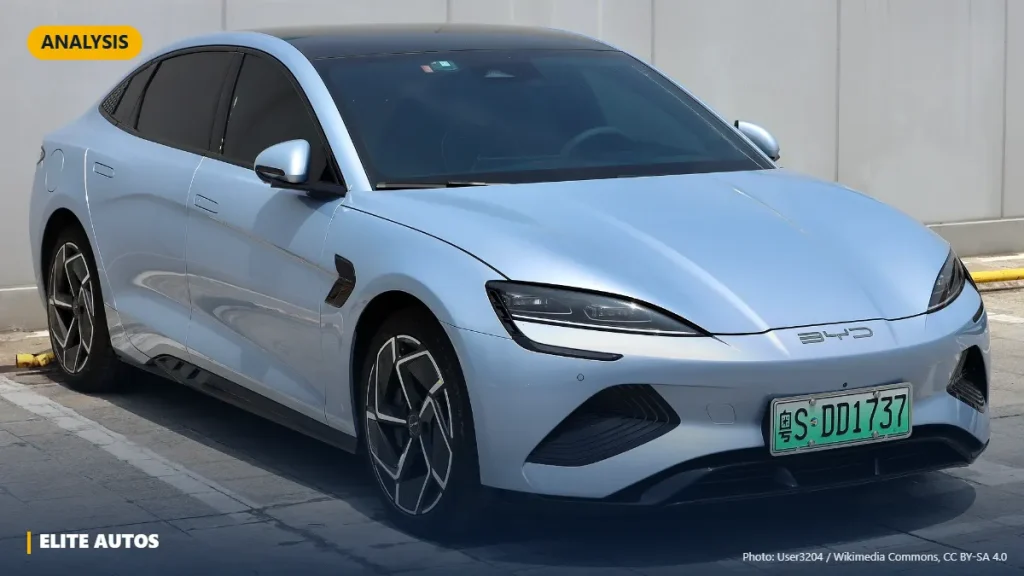
Quick answer: China builds far more cars than it can sell at home. A long price war has crushed profits, so carmakers are exporting at record levels: exports rose 65.6% in the first half of 2026, with new-energy vehicle shipments more than doubling (Commerzbank). The result is cheaper cars and tougher competition in Europe, the Middle East, Latin America and Asia.
In this article
The numbers behind the squeeze
| Measure | Figure | Source |
|---|---|---|
| Revenue lost to the price war, 2023–2025 | CN¥471 billion | Automotive World |
| Average car price, 2023 to 2025 | Fell 11%, from CN¥217,000 to CN¥194,000 | Automotive World |
| China domestic sales, Q1 2026 | Down more than 20% year on year | Caixin |
| Industry profit margin | 2.9% | Caixin |
| Exports, Q1 2026 | 2.23 million (+56.7%), over 30% of sales | Caixin |
| Exports, Jan–Oct 2026 | 9.736 million | Seoul Economic Daily |
| Idle capacity, 2024 | More than half | Bloomberg |
Why exporting is the escape route
- Margins are better abroad. BYD’s overseas gross margin was 19.5% against 16.7% at home (Caixin).
- Regulators keep stepping in. Beijing has intervened in the price war at least five times since 2025, without ending it (Automotive World).
- Factories cannot easily close. Local governments resist the job losses that consolidation would bring (Automotive World).
Who feels it outside China
- Europe: Chinese-owned groups took 10.8% of EU new-car sales in August 2026, up from 6.6% a year earlier (Euronews).
- Politics: Germany’s finance minister has accused China of not playing by global trade rules, and Beijing is now warning its companies against exporting price competition (KrASIA).
- Buyers: cheaper EVs and plug-in hybrids in markets without high tariffs, from Australia to the Gulf.
Elite Autos analysis
Overcapacity is the root problem; exports only move it elsewhere. Expect three things in 2027: more Chinese factories abroad to get around tariffs, more trade defences in Europe and emerging markets, and a slow shake-out of weaker Chinese brands at home. For buyers outside the US, the price pressure is good news; for legacy carmakers it is the biggest competitive threat of the decade.
October 2026: exports carry the industry
The squeeze deepened in the autumn. China’s passenger car retail sales fell 27.1% year on year in October 2026 to about 1.6 million, while exports, including kits for overseas assembly, jumped 68.5% to 928,000 and made up 35% of carmakers’ sales, up from 19% a year earlier (CarNewsChina). It was the 13th straight monthly fall in domestic passenger vehicle sales; electric cars made up 63% of exports, and BYD shipped 165,194 vehicles abroad, ahead of Chery, Geely and Tesla China (Yicai).
| Measure (October 2026) | Figure |
|---|---|
| Domestic retail sales | about 1.6 million (−27.1%) |
| Passenger car exports | 928,000 (+68.5%) |
| Exports as share of sales | 35% (19% a year earlier) |
| EV share of exports | 63% |
| Top exporter | BYD, 165,194 |
Beijing is tightening the export lifeline
Exports are not a free escape route. Beijing is cutting the export tax rebates that help make them profitable, and analysts expect the effect to bite by the second quarter of 2027, alongside a full year of EU quotas (Automotive World). The CPCA’s Cui Dongshu has said domestic retail sales could fall to about 18.5 million in 2026, the lowest in years (Qatar Tribune), while he expects exports to reach 12 million in 2026 and 18–20 million by 2030 (Automotive World).
What it means for Pakistan and the Gulf
For buyers in Pakistan, the UAE and Saudi Arabia, China’s overcapacity means more models, faster launches and sharper prices from brands such as BYD, Chery, Changan, Haval and MG. The risk is the other side of the same coin: if weaker brands fail or pull out, owners can be left with poor parts supply and weak resale values. Choose brands with a local assembler or a large distributor, and check parts and warranty support before buying. See our China car exports guide.
Key takeaways
- China’s domestic car sales fell 27% in October 2026 while exports rose 68.5%.
- Exports now make up about a third of Chinese carmakers’ sales.
- Beijing is cutting export tax rebates, which may squeeze weaker brands in 2027.
- Buyers abroad get cheaper cars but should check after-sales support.
Frequently asked questions
What is overcapacity in China’s car industry?
China has the factories to build far more cars than its home market buys. More than half of its production capacity was idle in 2024.
Why are Chinese car exports rising so fast?
Prices and profits are falling at home, and margins are higher abroad, so carmakers ship more cars overseas.
How much has the price war cost Chinese carmakers?
An estimated CN¥471 billion in revenue between 2023 and 2025.
Sources
- Caixin: Deepening profit squeeze strains Chinese automakers
- Automotive World: China summons automakers over price war
- Commerzbank: Will China roll over the European auto industry?
- Bloomberg: Massive overcapacity threatens to prolong price war
- Euronews: Chinese brands gain ground in the EU
Related: China’s car exports pass all of 2025 · BYD exports nearly double · China EV prices
This article was prepared with AI assistance and checked against the sources listed. Read our AI Use Policy and Corrections Policy.
Related on Elite Autos
 Brief: General Motors moves its stock listing from NYSE to Nasdaq
 Brief: Stellantis sells idled Brampton car plant to armoured-vehicle maker Roshel
 Pakistan vs India car industry 2026: sales, exports, ownership and growth compared
 Pakistan auto industry news, November 2026: $6bn export plan, Sazgar’s Philippines plant, fuel relief